

Editor
In November, Florida voters will get the chance to decide if they want to cut the property tax bill for homesteaded property owners—but it would come at the expense of local government budgets. Here’s the change—the standard $50,000 homestead exemption, offered to the owner of a home they reside in, would increase to $150,000 in 2027 and $250,000 in 2028 for most non-school property taxes. As a result, the taxable value of many primary residences would drop sharply, reducing annual tax bills and, in some cases, eliminating most county and municipal property taxes altogether for those who are Florida residents on Dec. 31, 2026. Those establishing Florida residency after that would generally have to wait five years to get the larger exemption, receiving only the $50,000 exemption during that period. Second homes, rentals and other non-owner-occupied residences would continue to pay property tax on their full assessed value.
Gov. Ron DeSantis has been the driving force for property tax cuts, stressing the need for relief for homeowners amid rising costs and surging home valuations that have sent tax bills soaring in the last six years.
“The proposal will increase constitutional protection against taxes for homestead properties and will be the biggest property tax cut in Florida history,” DeSantis posted on X earlier this month. “Floridians looking for help with affordability will have a great opportunity to vote for it.”
With that change, counties and cities would collect substantially less property tax revenue. To adjust, local governments would be forced to reduce spending, seek alternative revenue sources, delay projects, or restructure services.
Under the estimates approved by the Legislative Office of Economic and Demographic Research and shared by the News Service of Florida, local governments will see a $5 billion hit in the 20272028 fiscal year, followed by a nearly $8.8 billion cut the next year. In the third and fourth years after the approval of the amendment, local governments will get a $9.7 billion cut and $10.75 billion hit, respectively.
Supporters say homeowners would get welcome tax relief in a period of inflation and higher gas and grocery costs. Opponents—and government officials—warn of pressure on budgets for local services like law enforcement, fire protection, libraries, parks and road projects.
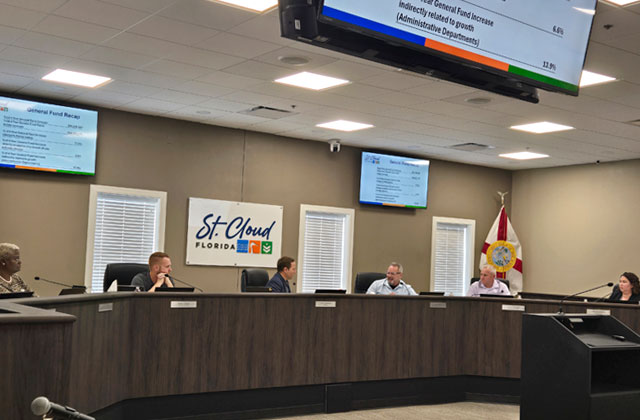
On Monday some of those local leaders—Osceola County commissioners and St. Cloud City Council members—each held workshops to discuss the potential impacts to local budgets should at least 60% of Florida voters move to approve the resolution on the Nov. 3 general election ballot.
During the St. Cloud workshop, City Manager Veronica Miller said the 2027-28 budget, the first one that would be affected by the property tax change, is long-term planning.
“Our first priority is the 2026-27 fiscal year,” she said, noting the city has made eliminating the use of prior-year fund balances to balance the city’s budget. The city had been dipping into those balances in the years since the COVID-19 pandemic—city records show insurance costs have nearly doubled during that time—but if spending can be trimmed in order to eliminate their use in the next budget the reserves would increase to $14 million.
Those reserves would be key to keeping the city’s budget whole in the first two years of the proposed property tax cuts. The city estimates that increasing the homestead exemption to $150,000 in 2027-28 would cost the city $8 million in tax revenue; that figure goes up to $13.73 million in 2028-29 with a $250,000 exemption.
Osceola County leaders said that figure would be close to $95 million at the county level.
“It’s going to be harder, with the growth rate we’ve seen, to add anything, let alone just keeping up what we have,” Commission Chair Bradon Arrington said.
At risk of the chopping block would be programs like Osceola Prosper, which covers the cost of a two-year degree or certification courses for county graduates at Valencia College or Osceola Technical College, and some road projects already in the planning stages.
“There has to be some sort of action we can take as a board to say, ‘Sorry Narcoossee Road, you can’t have another house, because these road programs just went from five, 10, 15 years build-out to now, 20, 30, 40 years,” District 5 Commissioner Ricky Booth said.
St. Cloud Finance Director Jeff Cooper said the city’s millage rate of 5.1128, where it’s been since the 2010s, would have to increase by to around 6.5, a 27% increase, to make up for those shortfalls. That was a non-starter for Council Member Kolby Urban.
“I would only consider raising the millage rate to get our own house in order,” he said.
Miller shared a list of things the city could do to get its budget down to respond to the tax rate cut, some more drastic than others: defunding vacant city positions, charging the Tax Collector’s office rent on its City Hall location, outsourcing or eliminating some parks and recreation and even fire or police coverage, canceling user agreements for facilities that the city partially or fully funds and canceling sponsored city events or summer camps.
“It’s doable, this isn’t panic time, just a long-range look at things to prepare for what might happen,” she said. “It’s like planning for a hurricane when one’s on the map.”
To show how drastic things could get, one of the items on Miller’s list was to sell the iconic St. Cloud water tower for around $2 million—but Mayor Chris Robertson didn’t like that.
“We’re going to get through this,” he said. “But I’m not going to sell the farm to do it.”