

Leaders, residents wonder about next step
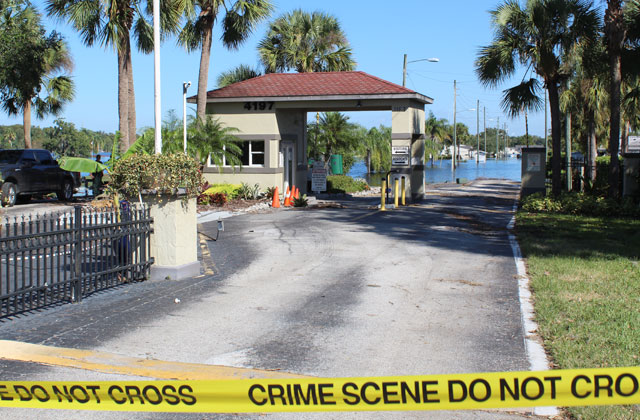
It’s a scene that, in pictures, looks like it should only happen once in a lifetime.
But the incredible flooding of Shingle Creek into the Good Samaritan Village retirement community after Hurricane Ian dropped 15 inches of rain looks eerily similar to the last time a hurricane directly affected Osceola County.
Hurricane Irma in September 2017 brought the same neighborhood-wide flooding that last week caused power to be deactivated and dozens of residents to be rescued by military-style vehicles when the water got too high to navigate.
“We’ve had several storms over the last 20 years that put Good Sam underwater,” said County Commissioner Brandon Arrington, whose district 3 includes the neighborhood.
The "campus," as its leadership calls it, is so underwater that residents are being told to relocate -- perhaps permanently.
“Unfortunately, several neighborhoods and homes have extensive damage due to the severe flooding. Any repairs could take months to complete, so we are encouraging these residents to secure other housing options,” said Aimee Middleton, Good Samaritan Society vice president of operations. “We are providing regular, real-time updates about Kissimmee Village through our website, social media, email, text, phone calls and in-person meetings. We will work on an individual basis with residents on unit availability.”
Cynthia Melendez, 62, who lives in a ground-floor Maple Leaf Shores apartment in the independent living section of Good Samaritan with her mother, got one of those calls. She was told that, after Good Samaritan had done its own assessment, that her home was a "level 3" -- the worst of the damage in the campus.
"Now we know where we stand -- that I doubt we can salvage anything, that we've lost everything," she said.
They evacuated on Tuesday, Sept. 27, the day before the storm’s rain began pelting the area.
“We weren’t told to get out. I happened to run into someone I knew from engineering on Monday, who said we were urged to evacuate,” she said. "To this day we haven't had any face-to-face contact with anyone from Good Sam. Just messages and a phone call from the corporate office in the Dakotas."
Melendez and her mother spent the next week at a Lake Buena Vista hotel – “I didn’t want to put my 85-year-old mother through being in a shelter,” she said – for a week until going to stay with a family friend in Polk County. "They are doing nothing for the independent living residents."
Arrington said he, County Manager Don Fisher, Osceola Emergency Management Director Bill Litton had a "spirited" conference call last week following the storm with Good Samaritan Village management about how to handle the current crisis.
“We realized something has to be done, we can’t keep putting a vulnerable population of seniors in the path of danger when a storm comes,” Arrington said. “We can’t keep allowing folks to occupy a place that’s detrimental to their wellbeing.
During the County Commission’s Oct. 3 meeting, Commissioner Cheryl Grieb noted, “If someone wanted to build there today, they wouldn’t be able to get the permit,” she said of building in such a flood-prone area.
At the same meeting, Fisher noted that the county could consider using eminent domain to purchase the area. The Federal Emergency Management Agency (FEMA) features a “flood buyout program,” which gives property owners the option to move from flood hazard areas, thereby reducing the amount of property damages and expenses from flooding.
Sheriff Marcos Lopez said that since Ian was forecast to be a Category 1 storm in Osceola County, it would have been “unlawful” to forcibly remove people from their homes.
“Before the storm, residents were advised this is a flood-prone area and they were strongly recommended to leave,” he said. “Once the county saw the situation getting totally out of hand, people who stayed were losing power, saw the water and began changing their minds and calling 9-1-1.
“(The county) made the decision to do a mandatory evacuation in order to prevent putting our officers in unnecessary risk," he said. There’s a fire truck (stuck) in the water (Melendez confirmed that). It became a safety issue for all of us, especially at night. There were hundreds of people taken out of here. Hopefully the management can get this place back in order as quickly as possible … but people aren’t going back to these homes anytime soon.”
While Lopez said, “I wouldn’t live here if they didn’t fix this,” he said that people can take the risk of living in a flood zone.
“A lot of people take that risk,” he said. “This is the worst we’ve seen this.”
The Melendezes lived at Good Samaritan during Hurricane Irma, and went back to their native New York for six months during that ordeal. Cynthia said there isn’t much of a comparison to the two storms.
“This is much worse. Five years ago you could look out and see grass in some places, with this it’s water everywhere. "With this, it would be another six months to get in, if the water goes down. But, we're not coming back."
She noted that since FEMA has not been in the neighborhood to do its own assessments -- they can't work off Good Samaritan's private assessments, she said -- her and her mother will have to wait for FEMA assistance.
"That assistance will be minor anyway,” Melendez said. "I've been calling around, trying to find our next place, and rents are high at other retirement communities in the area."
Florida Attorney General Ashley Moody said during her visit Tuesday that the state will be doing its own assessments to see if any investigations will be necessary.
“We’re looking at the quality of the water for the safety of the folks who want to get back in and get their belongings. It shows the work that needs to be done,” she said.