

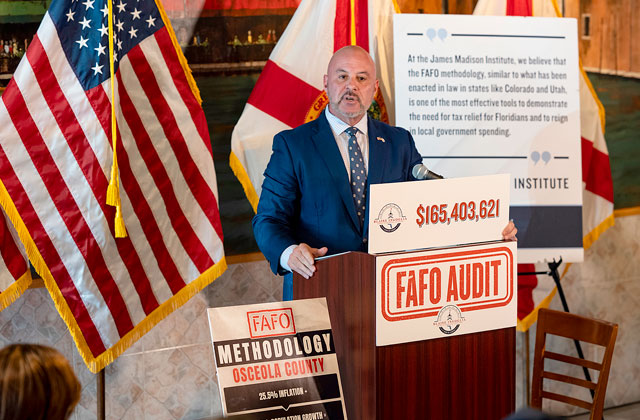
Those in Osceola County have been on the mind and lips of the state of Florida’s Chief Financial Officer.
Last week, CFO Blaise Ingoglia brought his crusade across the state to curb the “excessive, wasteful spending” of county and city governments to St. Cloud, where he addressed a small gathering at La Bella Napoli about how the Osceola County budget has been growing at a rate higher than what his math said inflation and the area’s population growth should put it.
Then, later in the week, his office announced that his office had turned a complaint, regarding Kissimmee Mayor Jackie Espinosa’s use of a city program that provided COVID-19 relief funds to business owned by her family, over to a Florida Department of Law Enforcement investigative unit.
Osceola County among a list of Ingoglia’s FAFO stops
Much like he’s done over the last couple of months in Florida, Ingoglia came to Osceola County on June 17 to talk about its general fund spending, noting its budget has increased by 102.35% since Fiscal Year (FY) 2019-2020.
“A budget increase of this magnitude for Osceola County is further proof that local governments have not been good stewards of taxpayer dollars,” he said. “Local officials would rather keep their large, bloated budgets than offer meaningful tax relief to their residents. The excessive wasteful spending identified in Osceola County to the tune of $165 million is money that could have remained in the pockets of the families that live here. This is why voters will finally be able to get real property tax relief on the ballot in November.”
That amendment that will appear on the general election ballot would, if it receives 60% support from state voters, would increase the exemption for those who established residency by the end of 2026 to $150,000 in Fiscal year 2027-- 28 and to $250,000 in 2028-29. In 2008, state leaders upped the homestead exemption from $25,000 to $50,000 for many homeowners including seniors and veterans.
Like he has done on his other stops around the state, the St. Cloud stop touted Ingoglia’s CFO office’s FAFO (Florida Agency for Fiscal Oversight) movement—a state-level watchdog initiative mirroring the federal DOGE (Department of Government Efficiency) concept. While the acronym officially stands for Fiscal Oversight, state leaders have not dispelled the coincidence of the double meaning of the popular slang phrase “F- Around and Find Out” signaling an aggressive stance against local governments adding to their budgets.
The FAFO formula takes into account inflation and population growth since 2020. Using that, Ingoglia said over $165 million was “excessive, wasteful spending” in its over $2 billion budget; that budget first crossed the billion-dollar benchmark in the 2010s.
“Osceola County is drowning in waste, just like many other jurisdictions across the state,” the CFO said. “They are taking your hard-earned tax dollars and spending them like drunken sailors.”
Yet, during his St. Cloud appearance, Ingoglia did not specifically mention or point to any county spending program, line item or specific instance where officials spent money wastefully.
Hours after Ingoglia’s appearance, Osceola County sent a letter to the CFO’s office that it made public. The letter asked for the opportunity to provide context regarding its growing budget, including “the unique factors that shape local decision-making.”
Among the five-page missive’s details: Population growth of over 200,000 residents since 2010 has increased demand for public safety, transportation, infrastructure, and other essential services; State statutes mandate Florida counties fund all or portions of specific programs like jail operations, retirement contributions, local Department of Health funding, and constitutional officers like the Sheriff, Clerk of Court, Property Appraiser, Tax Collector and Supervisor of Elections. Those alone, per county records, total $1.7 billion over the last five years; Seven new fire stations have been constructed, staffed and now maintained to keep up with population growth; $2.8 billion in road projects have been started, completed, or planned to keep traffic moving, such as Partin Settlement Road, Neptune Road, Poinciana Boulevard, Simpson Road, Neovation Way, Canoe Creek Road, Old Lake Wilson Road and others.
Welcoming over 10 million guests to Osceola County increases, “The need for transportation improvements, public safety services, and other essential government functions”; That nearly 97% of Osceola County’s current tax base growth is attributable to new construction which added new property to the tax rolls rather than adding new or increasing taxes on existing properties outside of their assessed values rising; The county’s budget includes about $175 million in federal and state grants to fund some of the road projects and operations at the NeoCity sensor technology campus.
“While these funds are appropriately included in the County’s overall budget, they are derived from external funding sources rather than local property taxes” the letter reads. “As such, it is important to distinguish these investments from locally generated revenues to provide a complete and accurate understanding of how County programs and services are funded over the past five years.”
Since demanding local governments comply with state DOGE/FAFO reviews without imposing any bureaucratic limits in August 2025, Ingoglia has toured the state accusing local governments like Osceola of spending excess nine-figure amounts of $40-340 million: in Orange, Hillsborough, Alachua, Broward, Seminole, Manatee, Palm Beach and St. Lucie counties, and the cities of Jacksonville, Miami, Orlando, St. Petersburg.
CFO will refer grant concerns to FDLE special unit
Last week Ingoglia’s office also announced it had turned findings from city documents showing Espinosa’s connection to the Business Boost 2.0 grant program to a FDLE special unit for its own audit review.
The complaint stems from allegations that three companies run by Espinosa’s family members collected $50,000 total from the program designed to use remaining federal American Rescue Plan Act funds earmarked to help local businesses recover from losses caused by the pandemic shutdowns. Espinosa and the Kissimmee City Commission voted to create the program in September 2025.
Commissioners voted to send the complaint to a special 9th District Court magistrate, but Espinosa’s legal team filed a legal writ to block that, noting that action was beyond the legal framework governing ethics investigations in Florida, and that any Circuit Court action would be outside of the state’s investigative process that should go to the Commission on Ethics. The 6th District Court of Appeals denied the writ on Thursday.
Special Magistrate Mayanne Downs, at a cost of $475 per hour, is now tasked with completing the investigation within 90 days and determining if there is probable cause for impeachment or to drop the case.
Reached by phone Monday, Espinosa said she did not want to get into the specifics of what she knows about how the complaints are progressing.
“I’ll explain the whole story at the proper time,” she said. “This is all strictly political, and people are going to hear what they want to hear.”