

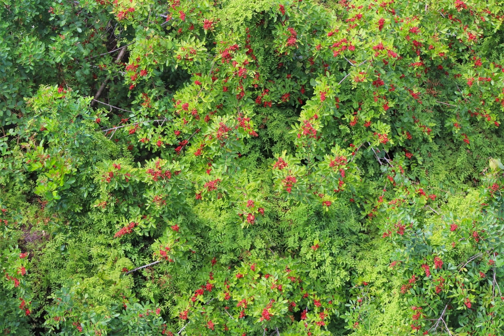
Isn't this what Florida is supposed to look like, with exotic tropical plants growing profusely? To the vacationer or the new resident, it may appear to be a plant lover's dream.
But the reality is that the photo is a better example of paradise lost than of paradise found. It shows an exotic ornamental plant which has gone wild. The bright red berries belong to what is considered to be the worst invasive plant ever to arrive in our state. Thickets of Brazilian Pepper currently cover about 700,000 square miles of land.
Let's look at it more closely.
Because of its beautiful berries, evergreen foliage, and fast growth rate, the Brazilian Pepper tree was imported as an ornamental plant back in the 1840's. Often called Christmas Holly, its berries and foliage were used as Christmas decorations. The Christmas berries are always present at just the right time of the year, after a fall blooming period.
Whether blooms are male or female, all are capable of producing much fruit. Berries are eaten and dispersed by birds and mammals, and the germination rate is very high. Capable of growing in most any terrestrial ecosystem, trees have sprouted almost everywhere. Pepper tree thickets have been found in pine woods, pastures, forest hammocks, urban landscapes, yards, mangrove areas, road margins, and even canals. Beautiful native trees, including real hollies, get choked out.
Reaching a height of about 33 feet, the Brazilian pepper tree has an attractive smooth trunk with a thick canopy. Leaves are 1-2 feet long, consisting of 3 to 13 leaflets. Looking at the thick deep green foliage, it is understandable that the nursery trade in 1840 felt that these would make nice trees. But due to their uncontrollable traits, they are now prohibited. This means that it is illegal to sell or purposely plant a Brazilian Pepper anywhere.
Unfortunately, I recently noticed that my own yard was not in compliance. One day, as I was pruning some large shrubs in the side yard, I came face to face with none other than a Brazilian Pepper tree. How could this happen?
Before we moved to this house, a yard company had forever been responsible for everything outside. Apparently unaware of invasive plants, the workers had shaped the tree as a part of the hedge for many years.
Well, the tree's stealthy attack was about to end. I began hacking on it immediately. Flowers had formed, but it was thankfully too early for berries. Due to many years of pruning, the tree was only about eight feet high, allowing me access to the branches. Fortunately, the soft wood was not too difficult to cut. Cut branches were thrown into the trash, not yard waste cans. I left it up to my husband to deal with the trunk, which was about six inches wide. He ended up painting it with a stump killer.
Getting rid of a pepper tree is not entirely without risk, as the tree contains urushiol, which is the same substance that is in poison ivy, poison oak, poison sumac, and poisonwood. Contact with the tree can cause skin irritation and rash. Breathing the pollen fumes during bloom season can cause respiratory problems for some people. Do not be tempted to burn the tree, because the urushiol in the smoke is a lung hazard when inhaled. And, every root will re-sprout anyway.
To safely get rid of a pepper tree, wear gloves and long sleeves and long pants. Small trees can be sprayed with brush killer, while large trees will require an application of basal bark herbicide around the lower trunk. This is best done during bloom season, from September through November. There is also the option of chopping the tree down. This can be done any time, as long as the stump is sprayed or painted with stump killer. This must be done within 5 minutes of making the cut.
Fortunately, researchers have been working on biological control and have recently come up with two insects which should be able to help with this unwanted tree. One is a type of thrips, and the other is a leafgaller, and both have been approved for use. They are host-specific to only Brazilian peppers and should at least slow down the growth of new shoots on pepper trees. More pepper pests from Brazil are being studied.