

What kind of creature can be heard wailing or screaming while stalking the swamps and marshes at night? While it might be possible that a Florida panther could be out there, I’ve yet to see or hear one. Baby raccoons and coyotes can make some strange noises, but they don’t quite match this description. We must look to the birds to find the answer.
This is the “song” of the elusive Limpkin. While this song most often occurs at night, it can be heard in the early morning or evening as well.
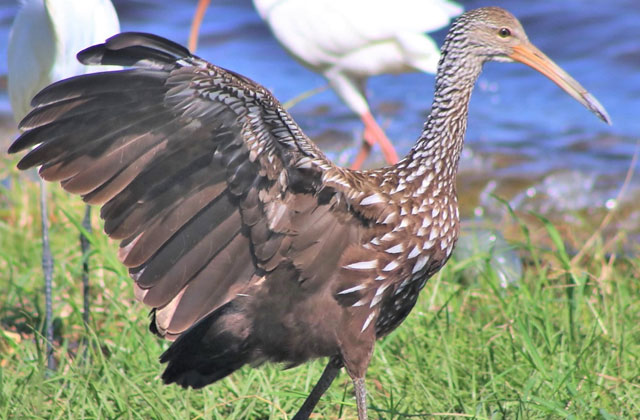
The limpkin, or Aromus guarauna, is a medium-size wading bird, standing about 28 inches high, with a 42inch wingspan. It is mostly brown, with some white streaks, as well as some white triangular patches. It has a down-curved bill, used to pry snails out of their shells. Maneuvering through native wetland vegetation, it blends in with its surroundings as it looks for the giant apple snails.
While the limpkin can eat mussels, insects, frogs, worms, and lizards, it is considered to be dependent on apple snails for its longterm survival. Although our native apple snail numbers have been declining for some time now, we do have a population of nonnative apple snails as well. Fortunately, this bird does not care whether the apple snail is a native one or an invasive one. Both are beneficial to the limpkin and to the endangered snail kite. In fact, an area without apple snails will not support either one of these birds. While the kites hunt by air, the limpkins stalk on the ground. Once found, snails are carried to a dry area for dining.
Due to the solitary and elusive nature of the limpkin, not much is known about the nesting habits and raising of the young. But their large platform nests of reeds and grasses have been seen in shrubs, in trees, in marshes, and on the ground near water. Nesting season is thought to be late February through June.
Florida is the only state home to very many of these birds, and the limpkin’s range also into the Caribbean, Central America, and eastern South America. Here in Osceola County, freshwater swamps, marshes, and shallow lakes are its home.
Limpkins were endangered years ago when hunters nearly exterminated all of them. Now, while no longer endangered, the birds still face some obstacles. The main threat is the habitat destruction of the apple snail. We also have invasive water plants smothering native vegetation and making it impossible for the birds to find any snails. Pollution is also a problem. Today the limpkin is listed as an imperiled species by some agencies.
My recent encounters happened after I spent quite a bit of time silently standing and waiting after hearing the wailing and screaming sound of the early morning.