


UF/IFAS Extension Osceola County Master Gardener
If you've seen bulldozers clearing away wild lands covered in palmetto, you would think that it must be a worthless pest plant. After all, one variety of it is called Saw palmetto because of the tiny saw blades on its stems. As a child, I was afraid of this one, though I did admire it from a distance. I later discovered that all of these small palmettos are actually useful and attractive. You won't find any of them on the "Do Not Plant" list.
There are at least three kinds of small palmetto, though the differences are not noticeable to the casual observer. All are native plants. The Sabal minor, or Dwarf palmetto, is a little easier to identify, as it has a flower stalk that grows above all of its leaves. It is also thornless. It prefers wetter areas than the other ones do. The second type, the Sabal etonia, or Scrub palmetto, grows in the dry elevated pine/oak areas of our county. In fact, it only occurs from Clay County to Lake Okeechobee, rather than the entire state. The Serenoa repens, or Saw palmetto, can be found in wet to dry hammocks throughout Florida.
The Serenoa repens and the Sabal etonia appear to be the same thing unless one looks more closely. The Serenoa name came about due to the presence of tiny sharp saws on its stems. Sabal etonia is definitely easier to walk through, as it usually does not have saw blades, though it can have some duller ones. The flower stalks do stay beneath the leaves, similar to the Saw palmetto. But there is a subtle difference in the leaves, which takes some close work to notice. Looking at the backside of a leaf, Saw palmetto is palmate, while Sabal etonia is costapalmate. Photos below will explain this. Saw palmetto can be found in wet to dry hammocks throughout the entire state of Florida.
While all varieties provide cover and food for birds, pollinators, and mammals, the Serenoa repens, along with the Slash pine, has earned the title of being a keystone species of the Pine flatwoods. The Saw palmetto fruit is a necessary food for over 100 kinds of birds, plus many mammals, reptiles, and amphibians, not to mention bees. It is actually a favorite food of the Gopher Tortoise. Berries are also eaten by black bears, deer, raccoons, opossums, squirrels, birds, and foxes. The Saw palmetto is a larval host plant for two types of skipper butterflies. The sweet honey is a delicacy.
In recent years, humans have been competing with animals for Saw palmetto berries which ripen from late summer to early fall. Probably every natural health store sells supplements containing saw palmetto. A Native Plant Harvesting Permit is now needed to harvest berries anywhere except on your own property. Since Serenoa repens often coexists with Sabal etonia in our area, I can't help but wonder if pickers end up with both kinds of berries. I have never seen evidence that the smaller etonia berries have the same health benefits as Serenoa repens berries, but at least they are not considered to be poisonous...
All of these palmettos are very slow-growing, and are generally not easily transplanted. Fortunately, native plant nurseries now sell them in pots.
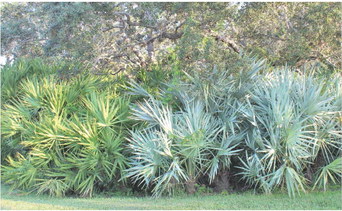
This is good news, since all types of palmetto do have a place in home landscapes. You can attract wildlife to your own yard while making an attractive planting. Saw palmetto is useful as a privacy screen which does not need to be sheared every week or two. It can also make a nice naturalistic cover under large trees. The color of the silver/blue variety can compete with that of the Bismarck Palm. The flower stalks of all Saw palmetto are very fragrant.
A very adaptable plant, Saw palmetto can grow in sun or shade anywhere in the entire state of Florida, and does not freeze. It is highly drought tolerant once established, and can take limited flooding. Sabal etonia does well in dry to moist well drained sites, while Sabal minor specializes in tolerating wetter areas. At least one of these should work in any yard.
While usually growing close to the ground, any of these can sometimes develop an upright trunk. A very slow-growing plant, palmetto will grow a little faster in a moist well-drained area. Mature size is listed as 5-10 feet.
To get started with a new plant, choose your site wisely and allow plenty of room for the clump to spread out. Keep it away from sidewalks, driveways, and kids' play areas. If you live in a fire hazard area, do not plant the Saw palmetto close to your house. Buy a potted plant. Do not try to dig plants up and transfer them to your yard. If they live, it can take 10 years for them to grow at all. Most plants seen in Florida are very old.
Once planted, water your palmetto often until established. The only other care would be to cut off dead fronds and dead stalks, as you would for any other palm. The fronds are actually a great source of calcium, which is useful for oak trees, so hacking them up and feeding them to the trees will work. They decay rapidly once in contact with the earth.
Reading more about Serenoa repens, I learned that many are clones. While the original plant is usually very old, the roots and new sprouts remain as the older ones die off.
In the wild, the silver palmetto is found along and near the east coast, while the green varieties grow throughout the state. However, both are capable of thriving in your yard.