

UF-IFAS Osceola Extension Services
In our area, we are fortunate to have a nice variety of butterflies which are most often seen from now through October. But what can we do to attract a few to our own yard?
As wild lands diminish and disappear and concrete multiplies, there are fewer areas for these beautiful insects to live. We must find them some plants that they like, and try to recreate their habitat. It does make a difference each time a yard is designed to be wildlife friendly.
First, the butterflies need nectar plants. These should be planted in a sunny area, since the butterflies love daytime heat. Use a variety of plant sizes with blooms in different colors and shapes. The good news is that the nectar plants are fairly easy to find — plumbago, firebush, bottlebrush, pentas, jatropha, bougainvillea, blackberry lily, hibiscus, tropical sage, and many more.
Since butterflies first appear as eggs, caterpillars, and pupae, they will also need some larval plants. This will allow them to stay in your yard for more than just a short period of time, for more than one generation. Most butterflies only live for a few days.
The list of larval plants contains mostly native selections. These plants provide both nectar for butterflies and larval food for caterpillars. The best ones are native butterfly weed, white swamp milkweed, wild cherry, pawpaw, purple passionflower, corky stemmed passionflower, wild petunia, redbay trees, purple thistle, beaked butterfly pea, saw palmetto, cassia, lantana, and wild lime.
The purple passionflower or the corky passionflower will attract our state butterfly, the Zebra Longwing. A Jatropha bush seems to work for nectar. In contrast to most other butterflies, the Zebra Longwing lives in moist woods or shrubby areas, which means that it can live in shade as well as sun. It can eat pollen, as well as drink nectar, and can survive for a few months. After eating passion vines, the caterpillar and adult become poisonous to predators.
These same two passionflower vines will also attract the beautiful Gulf Fritillary. The Julia butterfly also eats these but is not normally found here.
The Monarch and the Queen butterflies are the ones which love milkweed and native butterfly weed. Monarchs can live longer than most other butterflies and need plenty of nectar to make it to Mexico. There, they hibernate, and do not look for nectar again until they return to the U.S.
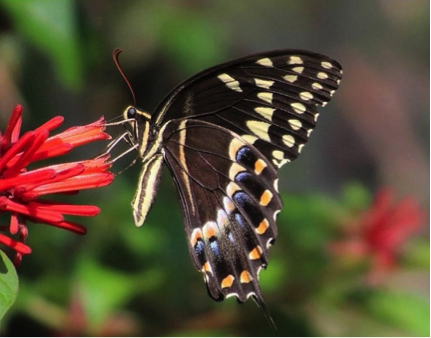
The Giant Swallowtail is sometimes considered a pest in spite of its beauty. This is due to its caterpillars eating citrus leaves. However, at this time, citrus has far worse problems than that. The larvae disguise themselves by looking like bird droppings. Wild Lime tree leaves are also eaten by the Giant Swallowtails. These native trees are related to citrus. Since they don't get greening, they would be a better choice for your butterflies, but don't expect edible fruit for yourself. The Hercules Club tree is also supposed to provide larval food for the Giant Swallowtail.
The Eastern Tiger Swallowtail can eat Wild Cherry and Sweetbay Magnolia. The Palamedes Swallowtail and the Spicebush Swallowtail require redbay trees for larval food.
The most important thing to remember is that your larval plants will get eaten if you succeed in attracting butterflies. However, these plants are able to recover from the temporary damage, so do not worry. It is also important not to use pesticides on these plants, and preferably not anywhere near them either. If your milkweed gets aphids, try blasting them away with a stream of water, so that your caterpillars will be safe.
Next to habitat loss, increased pesticide use is the worst threat to butterflies, as well as many other creatures. Blanketing the whole yard to kill every insect is detrimental. Be sure to I.D. the pest that you want to get rid of and follow recommendations for that specific one. Here are a few of the most lethal pesticides. They are Bt, neonicitinoids, organophosphates, carbamates, and insecticidal soaps. Note that even some natural products are included. The old favorites such as diazinon, sevin, and malathion are of course on the list of products to avoid. As you grow more native plants, a fringe benefit is that many are more heat/drought tolerant and less susceptible to pests.
Other things to keep in mind include providing shelter for your butterflies by planting shrubs and trees. The butterflies will also need water. The water can be put into a shallow pan with gravel in it.
Hopefully you will soon be able to enjoy a few nice visitors to your garden.