

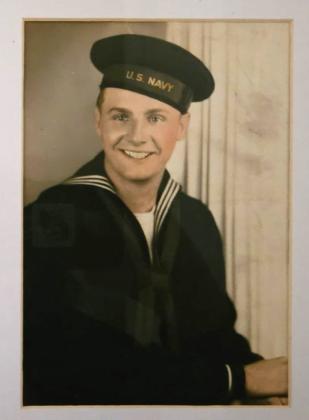
U.S. Naval sailor John Paul Church
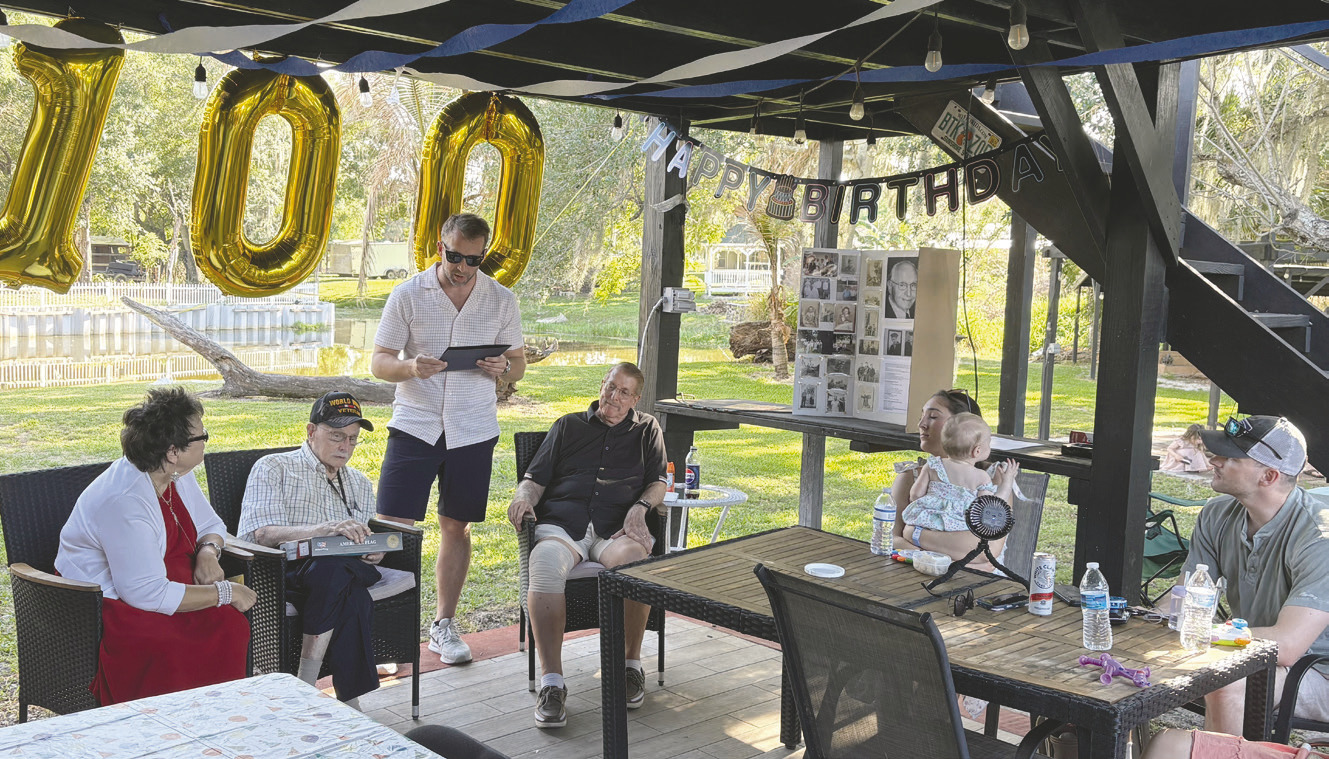
On a warm, quiet Saturday afternoon, John Paul Church, one of a dwindling handful of World War II veterans still with us, celebrated his 100th birthday surrounded by family and friends.
He was born in April 1926 in New Castle, Pennsylvania. During the war Church served in the U.S. Navy and saw combat in the Pacific Theater on board the U.S.S. Wilkes Barre, a light cruiser. He was part of the original crew, a “plank owner” in Navy slang, picking up the new ship at a shipyard in Camden, New Jersey in July 1944. He had two brothers who joined the U.S. Army earlier, one of whom would not survive the war.
“I joined the Navy when I was 17, I was ready to go,” said Church.
The ship sailed to the Pacific and was engaged in combat during campaigns in the Philippines, Iwo Jima, and Okinawa, and shelled the Japanese mainland until the end of the war. While he was trained to operate and maintain the ship’s steam boiler systems, he became a lookout up on deck, using large binoculars to search for enemy planes and mines floating on the water.
During one instance recalled by Church, during the invasion of Okinawa, the U.S.S. Bunker Hill, a large aircraft carrier, was struck by two Japanese kamikaze aircraft, with one also carrying a 550 -pound bomb. Huge fires broke out, and many of the crew were driven by the heat to outer sections of the ship. The Wiles Barre’s captain brought his ship “dangerously close” to the burning carrier to help fight the fires and allow sailors from the carrier to jump down to safety on the Wilkes Barre. In all, 396 of the carrier’s sailors were killed, and 264 were wounded.
The Wiles Barre was part of the grand fleet of Allied naval ships that sailed into Tokyo Bay in late 1945 when the Japanese government formally signed the surrender agreement on the deck of the battleship U.S.S. Missouri, which ended the long, dark years of World War II.
“I could use my big binoculars to see the Japanese, in their tuxedos and top hats, arrive at the Missouri to sign the surrender,” said Church.
After the war, he married Marian Gibson in 1947, and they had one son, Dan. Church worked for Shenango China and McClymonds Trucking in western Pennsylvania before retiring to St. Cloud in 1984. When asked if he had any advice on how to live a long life, he listed enjoying your friends and family and eating nutritious food.
His son Dan, three grandchildren, six greatgrandchildren, and one great-great-granddaughter, as well as many other relatives were on hand to help Mr. Church celebrate Saturday. His grandson Scott arranged for a flag flown over the Pentagon and read a congratulatory letter to Mr. Church from the Chief of Naval Operations (the Navy’s top admiral), both presented to him on Saturday.
St. Cloud Mayor Chris Robertson, who is also director of the county’s Museum of Military History, was on hand to congratulate Mr. Church on behalf of the city and the veteran’s community, as well as St. Cloud Police Community Engagement Unit.
The Church family wishes to thank the St. Cloud community for their recognition of John Church.