

Added revenue would go to fund teacher retention, sports and arts programs
The Osceola County School District intends to ask county voters for an additional one mill to help fund operational costs.
The initiative, which would appear on the Nov. 3 ballot in Osceola County, must be approved by the County Commission. That is scheduled to occur at the board’s July 20 meeting, but according to procedure, school district officials must present it prior to it becoming an agenda item.
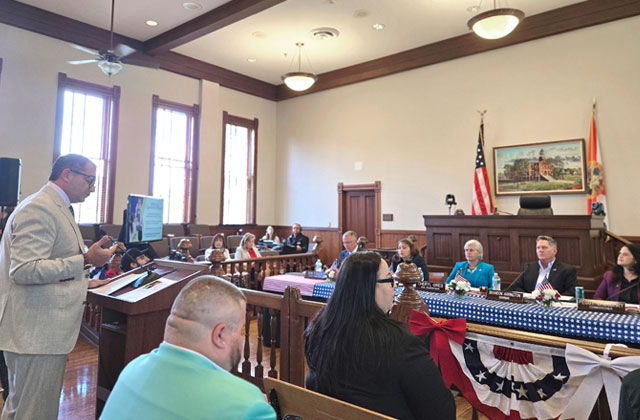
And that’s just what School District Superintendent Dr. Mark Shanoff did Monday, during a meeting commemorating the 250th anniversary of the ratification of the Declaration of Independence held across the walk from the county administration building in the Osceola County Historic Courthouse, Florida’s oldest courthouse still in continuous use.
The added Operational Millage would be added to district’s comprehensive school millage rate, bringing that rate to 6.306 mills. That’s the rate that property owners pay in taxes to fund schools; a “mill” is a rate of $1 for every $1,000 of assessed value. For example, at the new rate if approved by voters, a home assessed at $150,000 after homestead exemptions would pay roughly $946 in school taxes, as opposed to $796 without the assessment. It works out to about $12 per month more for those who escrow their taxes through their mortgage lender.
County commissioners like Ricky Booth, who sat on the School Board from 2014-20, made it clear their role was not to support or endorse the move, but administratively allow voters to decide it.
“I know how unfair the funding formula is for a county like Osceola,” he said Monday.
“I know the School Board is doing great work,” Commissioner Peggy Choudhry said. “One of the concerns I heard is that rentals would not be exempt, so it would be an additional fee for landlords (that they’d just have to pass on to renters).”
If approved it would go into effect in fall of 2027 and be in place for four years before it must be renewed or ended.
Orange County already has an operational millage; its school district says it goes to fund “essential operating expenses, such as compensating teachers and staff, and funding academic programs, arts, and athletics.” Other school districts also have it, or are considering it, especially in light of a state-wide referendum that would drastically cut property taxes by increasing the homestead (primary residence) exemption, although school taxes would be largely shielded from it.
Shanoff said it would be used to retain teacher and staff, maintain its school resource officer (SRO) program and the preservation of extracurricular academic programs, arts, music, athletics and student activities.
“We have the second lowest administrative overhead per pupil. Among the 67 counties, we’re operating very lean already,” Shanoff said. “We’re looking at a $100 million shortfall over the next four years. We’re trying to keep up with the marketplace, as opposed to trying to get ahead in any way shape or form. This is merely us trying to keep up.
"The idea of cutting more at the top in lieu of asking for an operational millage is difficult to accomplish because we already operate lean in our administrative expenditures."
District leaders say, despite the state Legislature increasing education funding per pupil, it’s spread across the state, meaning Osceola County remains 66th out of 67 counties in state funding per student. While the District isn’t adding programs, the costs for existing ones continue to grow.
“Should the statewide property tax measure pass, the ability for the municipality to shoulder the cost for the SRO program becomes burdensome,” Shanoff told commissioners Monday. The alternative would be private armed security in our schools.
Sports was also a consideration. As an example, while thousands of fans turn out on Friday nights for fall football games each week and hundreds turn out for basketball games a number of times a week in the winter, the associated costs of holding games are rising.
“We don’t do a lot of additive change orders to contracts, but where our change order actually hadn’t come in was in our referee contracts,” Shanoff said. “There’s only one referee association for football and volleyball; they get to set the rates.
“What brings students into a school isn’t necessarily what happens between first and seventh periods. You look at our schools with the gym on one side of campus and the theater on the other; it’s important to protect those.”
Osceola school officials have gone to voters in the past to approve funding referendums. In 2016, voters approved a half-cent sales tax referendum, taking sales tax in Osceola from 7% to 7.5%, which was earmarked for capital expenses like school renovations, security enhancements, technology equipment upgrades and facility maintenance. That will be in place until 2036.
“This community is always rallying around its tools, whether traditional public or public charter,” Shanoff said. “There’s no county in Florida where the alignment between county and city governments, the school district and industry are this strong.”