

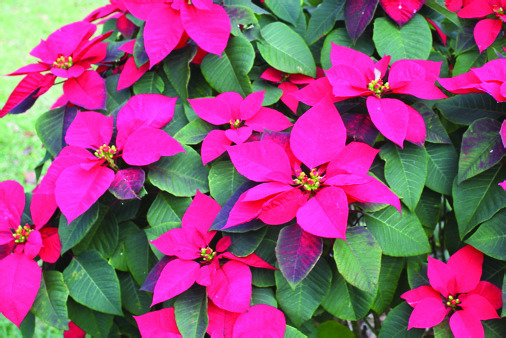
What would Christmas be like without colorful poinsettias? They now come in a variety of colors, which makes them even more irresistible.
Now the question is: with the holiday now past, what to do with these beautiful flowers?
It is interesting to note that the alluring colors of the poinsettia are actually not even flowers but bracts. The bracts are modified leaves, and the tiny yellow flowers are present in the center.
Earlier this year, I inherited two poinsettias after Christmas. I gladly accepted them in spite of the fact that they were not the best specimens — they were nearly leafless, while a few red bracts remained. I found the roots to be brown. But since it is always the thought that counts, I decided to gratefully give my gift plants a chance to revive.
They were given some fresh soil and a new pot, along with some pruning. Eventually they sprouted a few tiny leaves that did not last long.
What happened to these poinsettias? I had already known the answer to this question when I first poured the stale water out of the foil wrap. It is the most common reason for the death of the potted poinsettia. The roots will begin to rot if the foil is not either thrown out or cut off to allow water to drain. In order to prevent a flooding problem in your house, a saucer should be placed under the plant, and even that should be emptied after each watering. If you really can’t stand to cut or throw out the foil, at least quickly dump out all of the water each time the plant is watered.
Here are a few more tips on how to prevent death. Do not water until the soil feels dry. Keep the poinsettia in a well-lit area. (A porch with some sun is OK too as long as it does not freeze.) Do not fertilize at this time.
After Christmas is over, what do you do with the poinsettias? As a houseplant, they are a lot of trouble, needing to be put in a totally dark closet for 14 hours a night after Oct. 1. The good news is, that with proper care, they are capable of growing in your yard. And the colorful bracts can even last until planting time, which would be around March 1.
Once your poinsettia is ready to plant outside, it should be left in its pot while it adjusts to its new situation. First, it will need to sit in an area of partial sun. It may still need protection from any late frosts or freezes. Next, find it a sunny planting location in moist but well drained soil. The preferable pH would be between 5.5-6.5. Your site must not receive any artificial light at night, which will interrupt the bloom cycle.
After planting, apply mulch, and water your poinsettia as needed. Fertilize once a month between March and Oct. 1, using a balanced nitrogen and potassium mix which also contains magnesium. The middle number (phosphorous) should be low.
Your pruning schedule begins when flowers are faded and frost danger is over. New plants can be pruned to 12-18 inches from the ground. If plants are already smaller than that, stems can be taken to 4-6 inches from the ground. The pruning routine is necessary about once a month in order to prevent your plant from looking like a stick with few leaves. Prune new growth back to four leaves per stem, each time the plant grows another 12 inches. For older established plants, prune off old blooms and about a third of the total height. Then use the same procedure each time the plant grows 12 inches.
Discontinue all pruning and feeding by Oct. 1, since this is when flower buds begin to develop. At this time, your poinsettia must have about 14 hours of uninterrupted darkness per day. This means that it should not be planted near streetlights, security lights, flood lights, or under a window by the house. Even passing car headlights can aggravate the process. If conditions can’t be met, plants can be covered from 5 p.m. to 8 a.m. during the bloom setting period.
What about pests and diseases? Watch for aphids, soft scales, whiteflies, and spider mites, and treat if necessary. The poinsettia hornworm can defoliate a plant, so watch and remove if present. Also watch for fungal spots which can appear on leaves. The worst problem facing a poinsettia would be root rot, from being too wet.
If unaffected by freezing, the poinsettia will become a large shrub. With proper pruning, it will be very thick, rather than tall and spindly.