

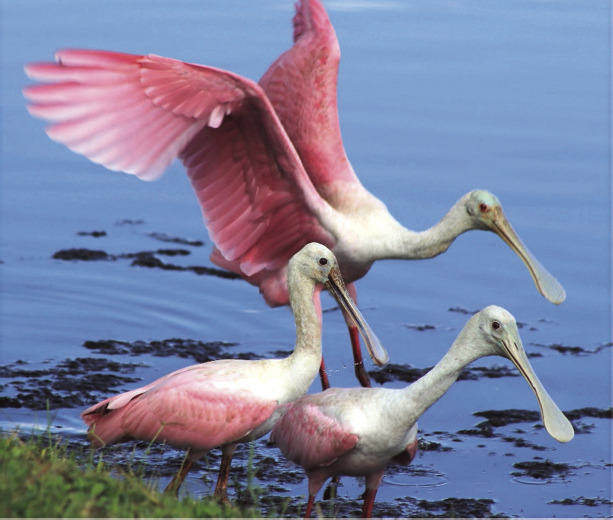
For many years, I have loved the beautiful Roseate Spoonbill, which is actually a water bird. Since I never found one anywhere nearby, I sometimes traveled to Sanibel Island to watch them hunt the mudflats there. Since then, spoonbills have been gradually increasing their numbers, and their range. The most exciting part of this is that they can now be found in some of the shallow lakes and wetlands of Osceola County.
While coastal marshes and mangrove keys are still favored habitats for a spoonbill, they’re also found in inland lakes, marshes, and wetlands. Any shallow body of water with a muddy bottom is an attractive hunting area for these birds. They do this by submerging their spoon-shaped bill into the water and quickly moving it from side to side. Small fish, crayfish, crabs, aquatic invertebrates, aquatic insects, mollusks, and slugs are caught and eaten.
The crustaceans and other invertebrates in their diet, which are high in carotenoids, are thought to cause their pink feather color. More often, the eyes appear to be brown, but even the eyes and legs can become reddish.
Spoonbills become more pink as they age, but young birds start out pretty white. The body stays white, with the wings and undersides changing to a deep pink over time. A few red markings are seen on wings during flight. A mature spoonbill will be 2 1/2 to 4 feet long, with a wingspan of 4-5 feet. This makes spotting one of these birds pretty easy.
Spoonbills are usually seen in groups. But for some reason, I will sometimes see a lone spoonbill spending its day foraging with a stork, which also hunts the muddy areas. While a spoonbill is not a small bird, the stork is even larger. The birds travel fairly quickly as they wade through the lower areas of the shallows with bills submerged. The stork may stop briefly to unbury some creature and pry it loose with its long bill. Both birds often end up with pieces of aquatic plants wrapped around their bills, and the legs and feet can temporarily get pretty muddy. But in spite of spending their days in the mud, the birds still look surprisingly clean.
Spoonbill nesting is often done in trees, from five to 15 feet above the ground. If no suitable tree is available, nests can be on the ground. The newly hatched birds do not yet have the spoon shaped bill, but the transformation begins after nine days. The offspring will stay in the nest for 5-6 weeks. Within 7-8 weeks, they will be able to fly.
Hopefully the spoonbills will continue to increase their numbers, as they retain their status as a state threatened species.
Photographing a spoonbill is a bit challenging. As with most birds, it is necessary to creep around silently, and then to not move. Once a spoonbill is spotted, it can be tricky to catch a photo in which the bill is not underwater. It helps if the shoreline is not to their liking in places, causing them to walk on dry land for a short distance. While the spoonbills are capable of swimming, they choose not to unless absolutely necessary.