

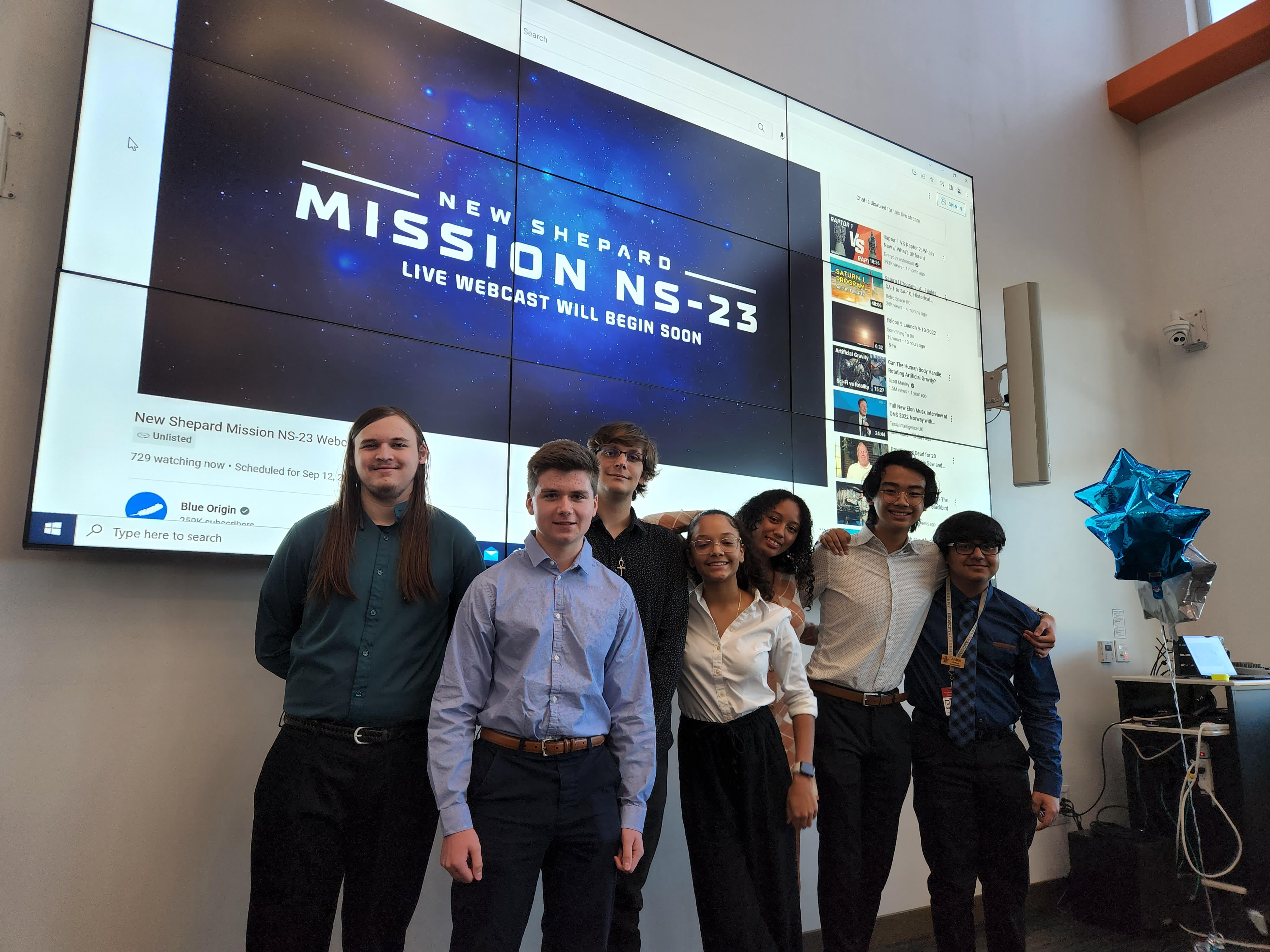

The students of NeoCity Academy, who had waited for over a week for conditions in Van Horn, Texas, northeast of El Paso, to allow the Blue Origin NS-23 rocket mission to launch, had to patiently sit through nearly an hour of countdown holds Monday before it finally rocketed majestically into the atmosphere around 10:26 a.m.
While most of the students, watching on a big screen in the east Kissimmee magnet school’s common area, were excited, the mood of seven students changed quickly.
Those seven, in the school’s engineering and biosciences tracks, had experiments onboard the unmanned mission to study the effects of microgravity on ultrasonic sound waves. The plan was for the capsule to spend three minutes at a low-gravity altitude to see how the sounds waves would react, in order to unlock further mysteries about sound in space.
But the rocket, with over 30 other scientific payloads on board from schools, universities and other scientific groups, experienced a booster failure “anomaly” and was only in flight for about two minutes, failing to reach microgravity.
“This wasn’t planned. We do not have any details yet,” the commentator on Blue Origin’s live feed said shortly after launch.
It was a disappointing development for NeoCity’s “Wings of Steel” engineering members like senior Jacob Brescia. He said advancements must be made in outer-space communication if routine travel to the moon, Mars or other planets will eventually happen.
“Sound waves on all spectrums are affected by gravity. We wanted to test is if an absence of gravity would affect frequency or amplitude of the waves,” he said. “With the development of future space travel, would we have to take that into account for, say, communication between planets or satellites? It’s a study of the next generation of communication.”
Jadon Duff, part of “Homolog22” biology team, the second team along with fellow senior Arianni Ramirez, said the effects of magnetic fields in space was what they’d hoped to study.
“Think of how a compass works. When you go into space, is that magnetic field less strong, or different?” he asked.
Ramirez said their project studied that magnification over several axis.
“Once the atmosphere ends, there are many changes as you go up,” she said. “This is field experience I didn’t think we’d get (in high school), so I’m glad the school had us experience this opportunity.”
The Belgian nanotechnology company imec, whose American outfit is in the Center for NeoVation across the street from NeoCity’s school, created a contest at the school for the right to send an experiment into space. Ten teams pitched proposals, and the two teams with eight members were selected.
Brescia, Duff, Ramirez, Kevin Baker, Elise Echeverry, Ceyan Ang, Aiden Adiram and Eron Cannon worked on the two projects.
Brescia said the team chose sounds waves over studying crystals or blood, because of their expense. The team’s hypothesis is that lack of gravity would affect the frequency of a wave, because of the change in density of what it passes through.
But, they’ll have to wait for a bit to see what data does come back from the mission. Their understanding is the experiments could go up on NS-25, the Blue Origin mission following the next one — no dates have been set yet for the next two.
Despite Monday’s setback, NeoCity Academy Principal Michael Meechin, who has led the school’s outside-the-box methods of teaching STEM subjects, said it was a highlight of the school.
“Aside from graduating our first class with 100 percent graduation rate last year, this is a close second,” he said. “We said we’d provide unique opportunities for our kids. This is … pretty unique.”