

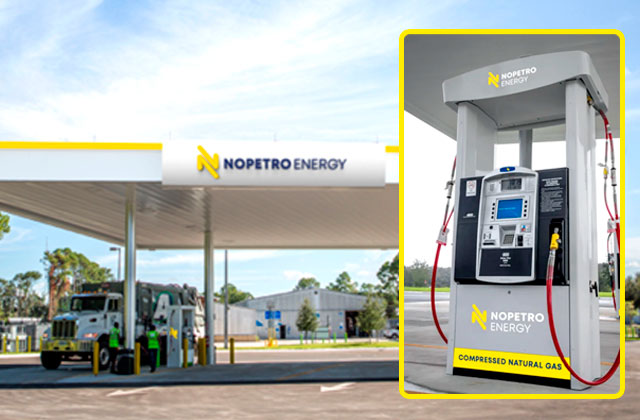
Nopetro Energy and LYNX are extending their decade-long partnership to construct a new bus fueling station at 100 N. Alaska Ave., powered entirely by renewable natural gas (RNG).
Expected to open by September, the facility will feature two fueling lanes designed to help the Central Florida Regional Transportation Authority scale its fleet efficiently. By utilizing RNG, LYNX can provide reliable, low-emission transportation to thousands of daily riders while benefiting from more stable pricing compared to traditional diesel.
“Public transit agencies need fueling infrastructure that keeps pace with their growth,” CEO of Nopetro Jorge Herrera said. “This new station strengthens LYNX’s ability to operate a modern, lower-emission fleet while managing costs and maintaining reliable service.”
The Kissimmee site marks Nopetro’s 15th CNG station in Florida.
This project builds on the company’s expanding renewable infrastructure, which includes a recent $50 million investment in Manatee County and an active RNG facility in Vero Beach that has been improving local air quality since late 2025.
For ten years, Nopetro has managed LYNX’s compressed natural gas ecosystem—from infrastructure design to fleet conversion.
This latest expansion ensures that as Kissimmee grows, its public transit remains both environmentally sustainable and fiscally responsible.
Chief Supply Officer Ed Hart stated that his company is opting to harvest landfill gas rather than allowing it to be flared off through traditional collection systems.
Hart said that while wastewater plants also produce methane, landfills provide a more consistent and higher volume of gas. This scale is crucial for the bottom line, as the significant volume at larger sites justifies roughly $40 million required to launch such a project.
“It is much safer than the alternatives,” Hart said. “When you’re talking about gasoline and diesel, if there is a leak somewhere, it vaporizes into the air. So, it’s not like it sits on the ground, like diesel, and it’s just an environmental mess.”
Hart said it’s a domestic product that burns clean and is cheaper than diesel.
“Operating and maintenance costs are better,” Hart said. “If you had to compare the price of diesel versus the price of natural gas, we’re probably only 60% of the price of diesel.”
Hart said that natural gas is not only a cleaner energy source but also a cost-effective one.
“They have increased their fleet of CNG bodies almost every year, so they are moving out as well as they can to all CNG,” Hart said. “That’s where the cost difference, the environmental difference, comes into play.”
While electric vehicles are ideal for city use and diesel remains necessary for long-haul trucking, he said that natural gas is perfect for return-to-base fleets—like buses or local delivery trucks—that can refuel at a central hub every night.
Hart said the new station will only be a fueling station with a canopy and two dispensers.
According to Nopetro Energy, RNG is taken out of the pipeline and compressed into medium and heavy-duty vehicles and buses, and transitioning these large fuel-consuming customers substantially displaces petroleum usage and does the environment a service.
“LYNX does a great job, and the more riders they get on transit systems, I think, is better for everyone,” Hart said.