

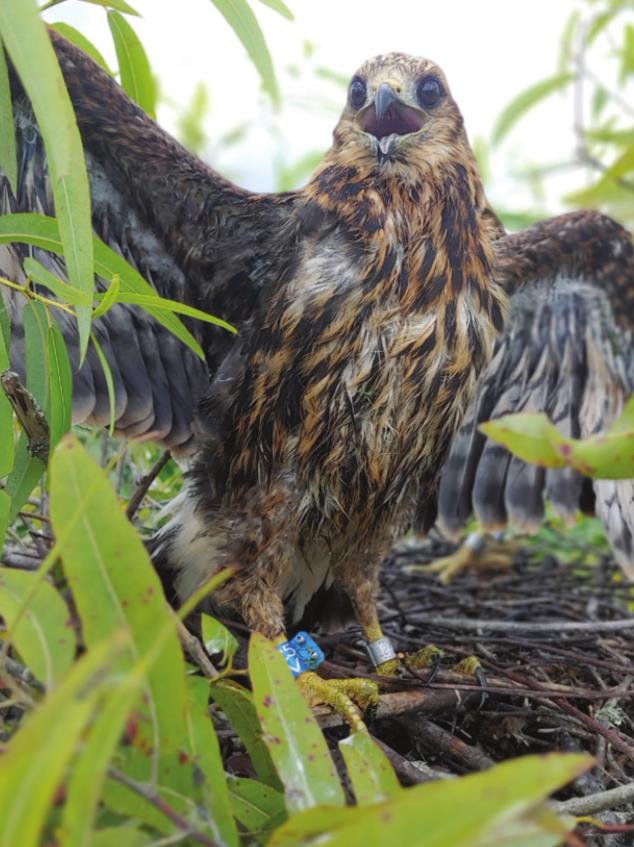
We know whether the endangered Everglade snail kite becomes more or less so every few hours. At least we do at Lake Tohopekaliga.
A research team is always counting. They use GPS trackers, nest cameras and airboats, not to mention old-fashioned binoculars, to ground truth all the data that comes in through the gadgetry.
The constant updates inform decisions on whether to let water in or out of locals call Lake Toho. It also guides decisions to restrict access in areas around nests or rip out weeds to make way for bass and tour boats without starving the bird.
Even if you don’t care about birds, this work might protect something you do care about—bass, if you’re a fisher, ducks if you’re a hunter, air boat tours if you’re a visitor or business owner or employee, and tax dollars if you’re a Floridian who benefits from the economic activity a healthy home for the snail kite generates.
University of Florida Institute of Food and Agricultural Sciences ecologist Rob Fletcher leads the statewide snail kite monitoring program. Fletcher is largely responsible for providing scientific information to answer questions of when to turn the lake’s plumbing on and off and other human controls on a wild space surrounded by busy boulevards, condos and commerce.
But the Florida Fish & Wildlife Conservation Commission (FWC), the U.S. Army Corps of Engineers, the U.S. Fish & Wildlife Service (USFWS) and the South Florida Water Management District depend on the Fletcher team’s data in deciding what to do at the lake and elsewhere throughout the kites’ range.
Fletcher and the FWC’s snail kite expert Tyler Beck took me out on the lake to see the bird. They brought along their colleague Vicki Garcia of USFWS, which enforces the Endangered Species Act.
That it only took about 15 minutes from the moment I stepped out of my car until I had a kite in my sights testified to how well they’re doing their job.
The snail kite is one of conservation’s success stories. Though it remains on the federal endangered species list, management efforts, like that of the government-university team, has helped the bird come back from the brink of extinction.
That’s why we need public support for environmental science. That can come in the form of funding, public participation in FWC meetings and other public policy forums, or citizen science initiatives.
Beck and other agency officials make Fletcher’s work relevant, not just the stuff of obscure academic journals. What they are doing is making it possible for us to live right up to the edge of where a bird struggles against extinction.
One of the strengths of a great public research university is the way it combines teaching with research. Graduate students in Fletcher’s lab are out there counting birds, documenting nest locations and tracking movement.
The field experience, education and collaboration with government agency professionals are preparing them to become the next generation of another small and select species — the wildlife scientist.
J. Scott Angle is the University of Florida’s Senior Vice President for Agriculture and Natural Resources and leader of the UF Institute of Food and Agricultural Sciences (UF/IFAS).