

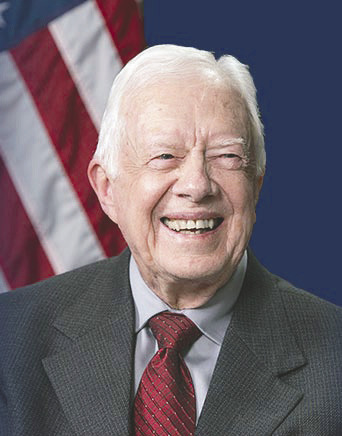
When tempted to make political predictions, I always think of President Jimmy Carter. During an off-the-record social occasion at the Georgia governor’s mansion a half-century ago, Carter asked a few reporters what we thought of his candidacy for president. Fueled by maybe a little more beer than necessary, I said he’d probably have a good time while it lasted but wouldn’t win. Two years later, announcing the appointment of Griffin Bell as U.S. attorney general in the same mansion, the president-elect spied the local press in a roped-off area and came over to remind me how I’d scoffed.
I was surprised he remembered but probably shouldn’t have been. The 39th president, who died Sunday at age 100, was a very smart man whose toothy smile and down-home Southern style masked some coldly calculating political instincts. A winner needs to “read the room,” as they say in show business, and none read better than Carter.
United Press International, the news wire service, had moved me from Tallahassee to Atlanta to cover the last year of Carter’s term as governor and then his long-anticipated bid for the Democratic presidential nomination. UPI didn’t want to waste one of its Washington heavy thinkers on a guy who had no chance, so I wound up flying around the country with him for months.
Carter, an ex-Navy officer and peanut farmer in little Sumter County, started as a school board member and moved up to the state Senate at the height of the civil rights movement. After Carter was elected governor in 1970, incumbent Lester Maddox moved down to lieutenant governor and spent four years warring with Carter, who Time Magazine put on its cover under the caption, “Dixie Whistles a Different Tune.” All of the 1972 presidential candidates made pilgrimages to Georgia. Meanwhile, Watergate was giving politicians a bad name. Carter’s simplistic message of, “I will never lie to you,” and his promise of a government as decent and honest as the American people were, would have seemed naive but for the lying of the Richard Nixon gang. No major candidates before Carter had described themselves as “born again” or taught Sunday school. His faith was real but also fit the image that seemed so new and reassuring in the post-Watergate era. So Carter came into 1976 as a choirboy, up against such insider Democratic pros as Gov. George Wallace of Alabama, whose “Segregation Forever” vow of 1963 still resonated across the South.
Carter correctly calculated that a Southerner without Wallace’s racist past could win by running everywhere. He entered every primary and caucus, deploying his “Peanut Brigade” of Georgia supporters to ring doorbells and hand out leaflets for him in New Hampshire and Boston. A first-term senator, Joe Biden, was the first member of Congress to endorse Carter, breaking with a Washington establishment that was staying neutral out of respect for ex-Vice President Hubert Humphrey’s possible fifth national campaign—which didn’t happen.
The turning point, Carter’s big break, came in Florida on March 9, 1976, when he soundly defeated Wallace in a heated primary. His delegate lead was insurmountable. Carter got an unexpected boost when Republicans split right down the middle, with Ronald Reagan almost taking the GOP nomination away from President Gerald Ford. Carter was critical of Ford for pardoning Nixon and scored more in their three debates, especially when Ford inexplicably insisted there was no Soviet domination of Eastern Europe.
World events during Carter’s presidency—particularly gasoline prices, mortgage rates and the Iran hostage crisis— conspired against him so badly that he lost 44 states to Reagan in 1980. But he lived longer than any other president thus far and redeemed his place in history.
Bill Cotterell is a retired Capitol reporter for United Press International and the Tallahassee Democrat. He can be reached at wrcott43@aol.com.