

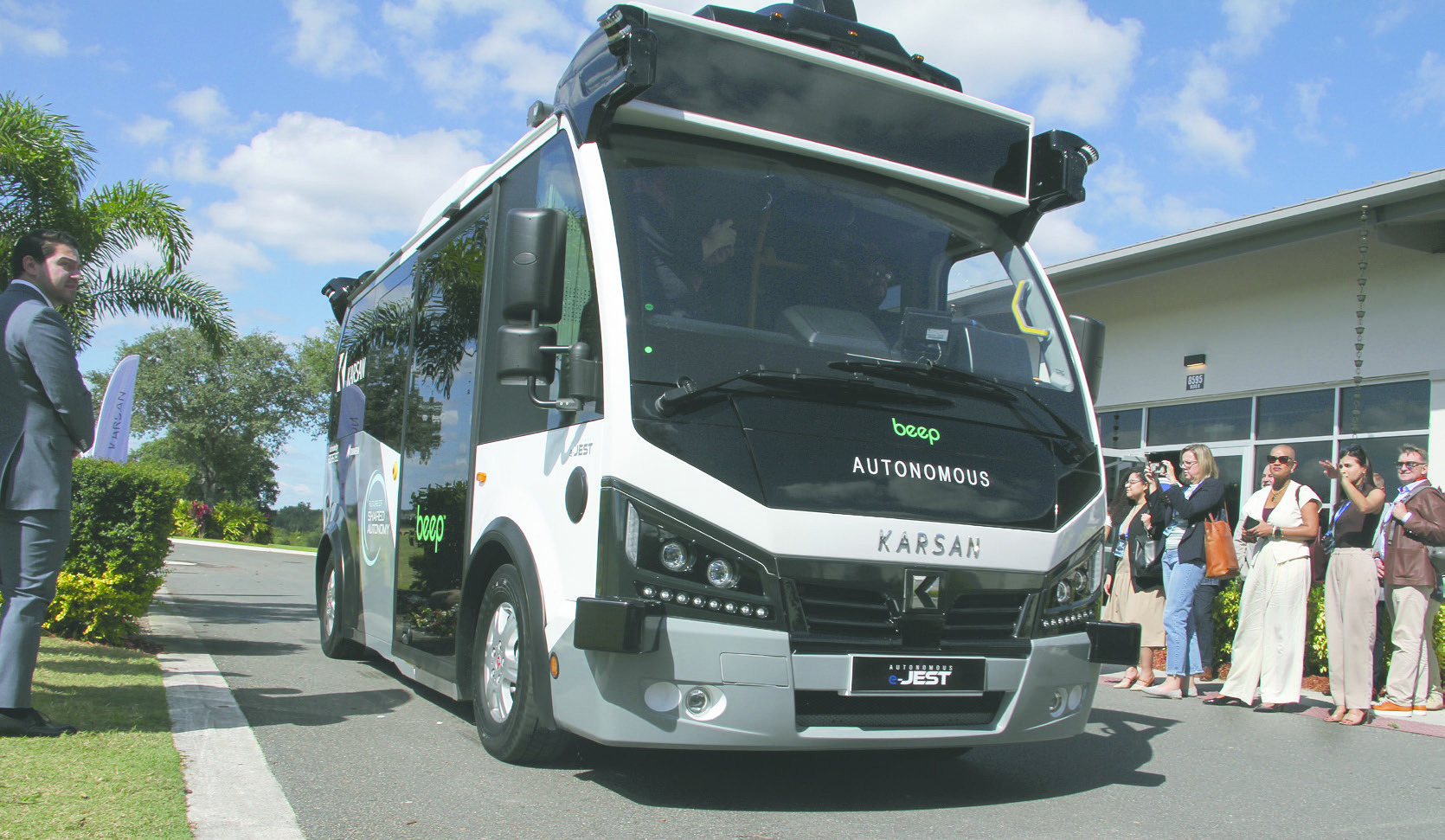
International bus manufacturer Karsan rolled out e-JEST, its new autonomous electric mini-bus, to the American market at the Florida Autonomous Vehicle Summit on Nov. 5.
Deniz Çetin, Chief Commercial Officer of Karsan, led the event which showcased e-JEST and its North American partnerships in the Central Florida area. The presentation along with a test drive session was attended by stakeholders in the autonomous transit industry.
A 60-year leader in the bus manufacturing industry, Karsan is based in Turkey with distribution across the globe. The e-JEST has operated worldwide since 2018 but its recent conversion to autonomous was introduced by Karsan at the annual BusWorld convention in Brussels, Belgium in early October.
Autonomous transportation isn’t new to Central Florida. In conjunction with Florida’s Department of Transportation and Beep, Inc., the City of Altamonte Springs has been running CraneRIDES, a citywide AV shuttle program, for nearly three years. Looking to upgrade its current vehicles, the city is embracing the e-JEST model to continue its commitment to innovative transportation, driving residents around Altamonte Springs between stops like the mall, the hospital, and SunRail.
“We’re the longest running permanent autonomous vehicle deployment by a city in America,” explained Frank Martz, City Manager of Altamonte Springs. “We believe that to have a sustainable community you have to have mobility choices for people.”
Karsan’s e-JEST has gained international popularity as an ecofriendly, zero-emissions nimble urban bus that is fast-charging and ADA compliant. It’s maneuverable on narrow streets, in mixed traffic, and all-weather conditions. At just over 19 feet long, it can carry up to 19 passengers with panoramic windows, USB ports, and WiFi throughout. But it’s the addition of autonomous technology that brings the vehicle into the future.
Cemre Kavvasoglu is the Product Management Director of North America for ADASTEC Corporation which engineers the software that powers e-JEST. “We have a very comprehensive system that is capable of detecting all pedestrians, cyclists, all road users around the bus and also inside of the vehicle,” he said.
Fixed-route AV systems are spreading throughout Florida. Karsan’s operational provider Beep, Inc. has been running Move Nona for five years in Lake Nona and more recently the NAVI service around Jacksonville.
Still, there are mixed opinions.
“There are two types of reactions. One is those people, they see this as a novelty, fancy, showing off, shiny,” said Çetin. “But some other people, they see and they understand that this technology is the real solution to address our real transportation problems.”
Challenges facing the transit industry include traffic congestion and a shortage of drivers, particularly for latenight and weekend routes.
On a scale of 0-5 on the Society of Automotive Engineers (SAE) levels of driving automation, vehicles like e-JEST operate on Level 4, considered high-automation.
They can drive on restricted geographical areas (“geofencing”) and without the requirement of a human driver, often using a driving attendant instead.
But how safe are autonomous vehicles? Driverless vehicles gather data from cameras and sensors along with Light Detection and Ranging (LiDAR), radar, GPS, and sonar systems for 360-degree scanning visibility. Specialized software along with AI processes use real-time decision-making to navigate roadways efficiency and safety.
“It’s connected to the internet, it’s connected to the traffic lights, it’s connected to transportation planning systems,” said Brent Phillips, Founder and President of Nexus Bus Corp. of West Palm Beach. “The bus can actually pay attention to a lot more of what’s going on around it than a single human driver could.”
Çetin says public acceptance and comfort are within reach.
“You know, elevators used to have drivers. And now, there’s no drivers in the elevator. None of us are asking questions if it is safe or not. You take it for granted,” he said.
Proponents aim to free up roadways and give people the option to ride, rather than spend time behind the wheel.
“So our community has embraced it. They just see this as the next thing that their city is doing,” said Martz. “If you make it about the people and you give them their time back, they have a different value to it, because they value their time.”
Phillips added, “When you enhance mobility for anybody, you enhance mobility for everybody. And mobility is opportunity.”