

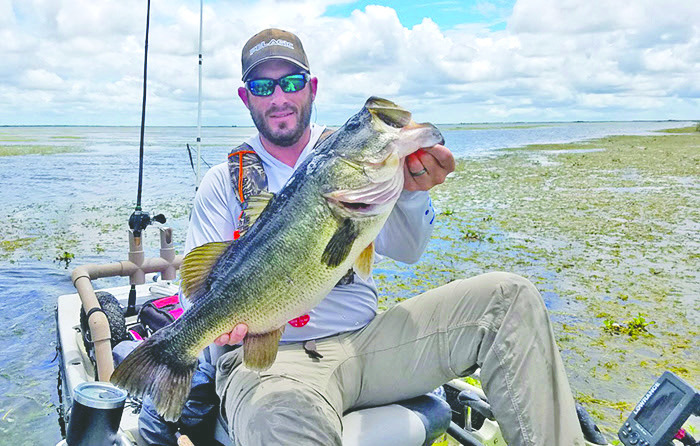
Have you been out on the water and reeled in a “catch of a lifetime”? The Florida Fish and Wildlife Conservation Commission (FWC) wants freshwater anglers to be prepared if they catch a bass large enough to be the new state record.
Here’s how to certify it: First, contact the FWC via an online form or by calling an FWC regional office listed on the FWC website (Monday-Friday, 8 a.m. to 5 p.m.). An FWC biologist must confirm the fish species and potential record weight.
Next, an FWC employee must witness the fish being weighed on a certified scale. Staff will provide directions on how to best accomplish this.
Once an angler contacts the FWC, a biologist will coordinate to provide direction on how to best work through the certification process. False alarms are common! Be prepared to provide a photo of the entire fish on a scale with the weight legible when possible.
The current state record bass weighed 17.27 pounds and was caught by Billy O’Berry in Polk County in 1986. Although that record has stood over 30 years, anglers and biologists alike are asking when the next state record will show up based on recent submissions of giant 15- and 16-pound bass to FWC’s TrophyCatch citizen-science program. Anglers can check the current state records at BigCatchFlorida.com by clicking on “State Record.”
You do not need to reel in a state record to earn recognition for your trophy-sized bass catches! Participate in FWC’s TrophyCatch program and win prizes for catching and releasing bass 8 pounds or larger. Learn how to participate at TrophyCatch.com.
So get ready to log those largemouth bass … excuse me, we mean … Florida bass!
The FWC says genetics studies confirmed what many anglers and biologists have believed for a long time – Florida bass are special!
The American Fisheries Society established the Florida bass as a separate species from the largemouth bass. This means that in most of Florida (except the western Panhandle) what was known as a largemouth bass is now called a Florida bass. The scientific names of these two bass also changed. Largemouth bass, previously Micropterus salmoides, is now the scientific name for Florida bass. Largemouth bass are now Micropterus nigricans.