

St. Cloud High students shown wonders of micro-circuitry last week
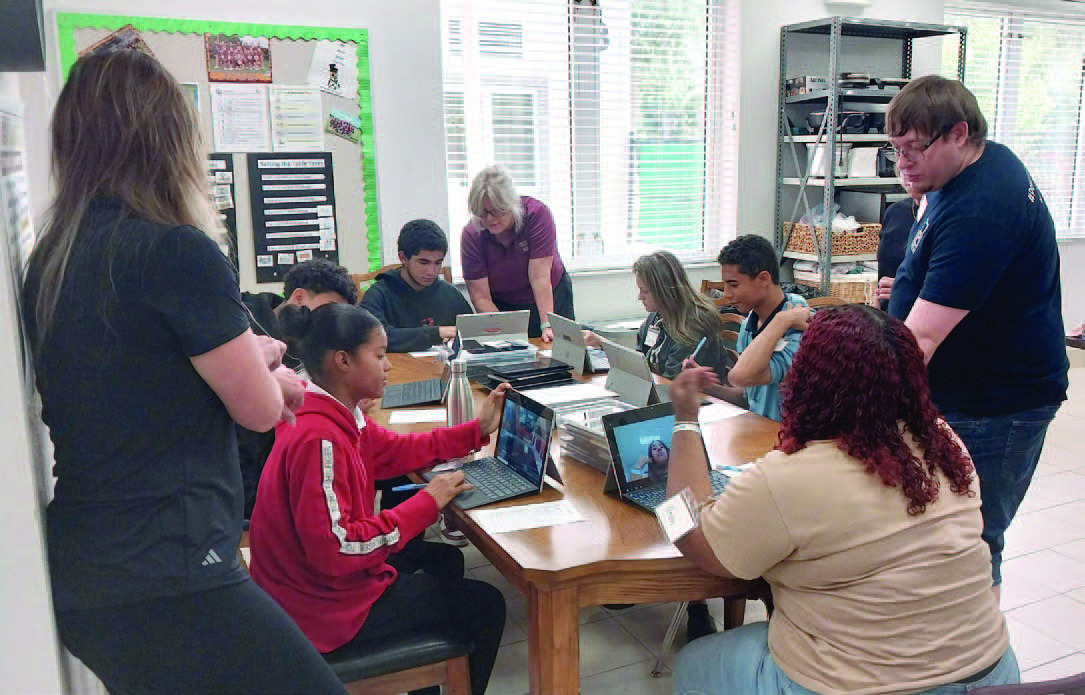
St. Cloud High School welcomed Techtonic’s SKILLCircuits last week to offer neurodiverse students, such as those with autism, a future in mobile device repair.
Chief Impact Officer for Techtonic Christopher Johncke said they have been running these skill circuits across Orlando, but this will be the first time it’s being done in Osceola County.
“Osceola has been a great partner for us in developing what we’re doing and helping create opportunities,” Johncke said. “That’s what we’re here to do, create opportunities for everybody.”
According to Jonathan’s Landing, they are creating career pathways for neurodiverse talent to thrive, with workshops broken down into three sections—computer inspection, cellphone screen and battery replacement, and laptop disassembly and repair.
“We find individuals that are exceptionally skilled at hyperfocusing on cell phone, tablet, and computer repair, then we try to encourage and uplift them to learn more about it,” Johncke said. “Our programs introduce this type of work to individuals who are often overlooked or may have challenges with finding a job or looking for something that really sparks an energy and a passion.”
Johncke said this first time working in Osceola has been amazing.
“The school district is very supportive of continuing education and technical skills, and what we’re providing here is a really great pathway to finding meaningful employment with our organization and other organizations by giving them a passion and a drive to learn more about technology,” Johncke said.
St. Cloud High School seniors Helen Delie and Allyson Brioso said they are happy to learn something new. Brioso said she likes working with cellphones and laptops.
“I liked seeing inside the phone,” Brioso said. She said her favorite part of the workshop was seeing how laptops worked from the inside.
Delie said she wasn’t interested in laptops and phones, but she was glad to learn something new about them.
“I learned new things with laptops,” she said. “I didn’t know anything about laptops, and so I found out how to unscrew them and see how things run in the back of your laptops that you never thought it would.”
Delie said her favorite part of the workshop was learning about the inner workings of laptops and phones with the guidance of the instructors.
Tim Burdette, the Executive Director of Secondary and Post-Secondary Career and Technical Education and Adult Education for the Osceola County School District, said the turnout of these workshops will result in 50 students getting their micro-certifications.
“It is amazing,” Burdette said. “Yesterday when I saw how many showed up, it brought tears to my eyes, seriously it did, because they were graduating,” Burdette said.
Burdette said that the team chose St. Cloud High School for this workshop because it has a warm group of teachers who work with the students.
“Think about a student who is 21-years-old, has special needs, and is probably living at home,” Burdette said. “Think about if something happened to their parents, where do they go? There’s no service past 21 or, you know, in the school system, so they either have to go into another family, or they get put into some type of system and they get taken care of.”
Stephen Darago, Career and Technical Education coordinator for the Osceola County School District, said if all works out, they are going to pilot these workshops all over the district by next year with Jonathan’s Landing. The micro-certifications allow these students an opportunity for employment, especially in an area where NeoCity is working to build a small electronics research and manufacturing hub.
“The ultimate goal is that they are going to build a 500-residential facility, and we’re going to have students in transition live there and then try to transport them into wherever they get employed,” Darago said. “We want them to be functioning members of society. We want them to have the same opportunities that all students have.”
Darago said they want to make that inclusiveness happen for the students as long as possible.
According to Techtonic, the local community can help neurodiverse students by donating their unused phones, tablets, and laptops to the Million Device Drive. Details are at http://techtonic.world/million-device-drive/.
Johncke said he was amazed by the student’s capabilities.
“There are some really amazing individuals that are able to go in, and they are able to jump right in and take a computer apart, a phone apart, and grasp the concepts of taking something apart and putting it back together,” Johncke said.
For more on the program go to https://jonathanslanding.org/skillcircuits/.