

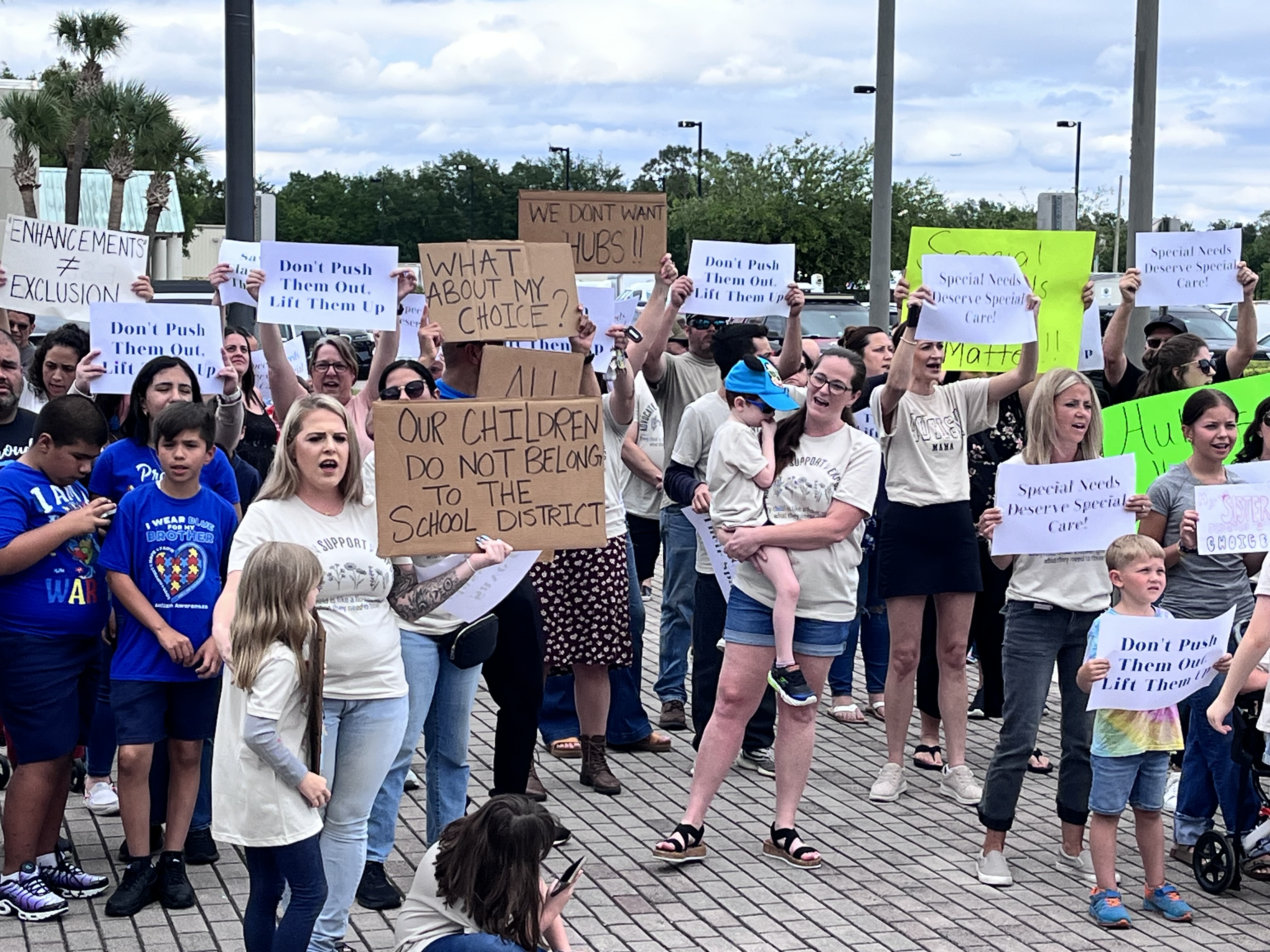
Parents of Osceola County Exceptional Student Education students are still fighting for what they say they know to be best for their children. Shouts of “Special needs deserve special care!” echoed at Tuesday night’s School Board meeting as dozens of parents and their children rallied in protest of the upcoming changes to Osceola’s ESE program.
Announced last month, the changes will reduce the percentage of ESE students in separate classrooms by relocating some to “hubs”—centralized schools aimed at consolidating specialized staff and resources—and offering more opportunities to join general education settings.
At a March School Board meeting, the District explained that while the State target for ESE students in separate classrooms is 12.7%, Osceola’s percentage was at 21.4% as of January 2025.
That is not a new development, though. According to the Florida Department of Education Local Education Agency Profile, Osceola has been at or above 20% since 2014, going as high as 23% from 2014-2016.
“We cannot sustain serving all exceptionalities to the letter of the IEP (Individualized Education Plan) at all schools utilizing our current ESE model,” Superintendent Dr. Mark Shanoff said at Tuesday’s meeting. “We are focused on guaranteeing exceptional education students the services they are due. Without redistricting, which is not on the table, we do not have space in certain schools to continue the current model.”
Shanoff cited flat funding from the State, rapid growth in the county, and ESE staffing challenges as necessitating the changes. The District has updated its website to include “Clarifying Myths vs. Facts.” Parents are encouraged to visit https://www.osceolaschools.net/domain/135 for that information.
A number of parents who oppose the changes rallied before the meeting, then stayed and shared impassioned pleas to reconsider during public comment.
Lissette Velez said she would have to quit her job in order to drive her son Kevin, who is paralyzed from the chest down due to spinal cancer and has severe developmental deficits caused by high doses of radiation, to his new school.
“It’s 48 to 56 minutes to his new school,” she told the Board. Though the district could provide transportation for her son, Velez said that, because of his risk of seizures, that is not an option. “I will need to resign my work in order to take care of him, and this will affect not only him, but our family. It will be unsustainable for us.
“Fighting for Kevin's life is an everyday thing, and now we find ourselves fighting for his education. This is not right.”
Transportation was a common topic among the parents.
“There's no way you're going to put my child on a bus, because he's an elopement concern,” Eric Gentry said. “He will run off. I have dead bolts inside my house to keep him in. It's not acceptable.”
Parent Brian Bent, representing parents with non-verbal students, encouraged families to speak individually with District personnel about their concerns to see if their specific needs can be met, which is what happened in his case.
“What I've got is a child that can't talk. He can't express anything about what he needs. He can't tell me when he's getting abused at school … that is what all of these parents are afraid of,” he said. “Any of us that have a nonverbal child, to put them in a new setting where we're not comfortable with them is an absolutely crippling fear.
“I would ask all of the parents to take advantage … let them know what your specific needs are, because if you let them know what your specific needs are, they can be addressed.”
Joann Castro agreed that parents of nonverbal children fear for their safety. “I'm going to be honest: inclusion is not in my top five,” Castro said. “Maybe later on, when she is the middle school and high school. But right now, safety is the big issue. I am not putting my child on a bus with people that I don't know, to show up an hour later. We hear terrible stories of what's going on with autistic kids.”
Deputy Superintendent Dr. Rene Clayton said that, based on some of the feedback they have received, the District has decided to open two additional hubs, which may help alleviate some transportation concerns. “We have realized that we have the need to add the separate class setting hubs, to move what was going to go to one location to limit some of the drive, and we were able to make it work to add to St. Cloud Elementary School and St. Cloud Middle School,” Clayton said.
Cases like the Bents’ and the addition of two more hubs illustrate the value of communication, which parents and Board members alike say was lacking early on.
“I think 90% of this is lack of communication,” Gentry said. “We just had an IEP meeting a couple months ago, and none of this was brought up to us.”
Board member Paula Bronson agreed. “I'm going to be honest: I didn't know it was coming, and two days before the last Board meeting, I was presented with that very first PowerPoint. As a Board member and as an educator, I did not feel set up for success. So I can't imagine how the parents have to feel,” she said.
Shanoff acknowledged that the changes could have been communicated better. “There are things that have been communicated that I wish had been communicated better … from me. I own that,” he said. I'm a member of my team. I’m the superintendent. If things aren't communicated effectively, that falls on my shoulders. That is my responsibility,” Shanoff said.
Clayton said the ESE department has fielded 145 calls specific to these changes and has facilitated 10 individual meetings with families, and urged parents to schedule a one-on-one meeting with District personnel.
“Most (issues) have been resolved via the phone call, because they've been able to determine what is related to their individual situation and get those questions answered.”