

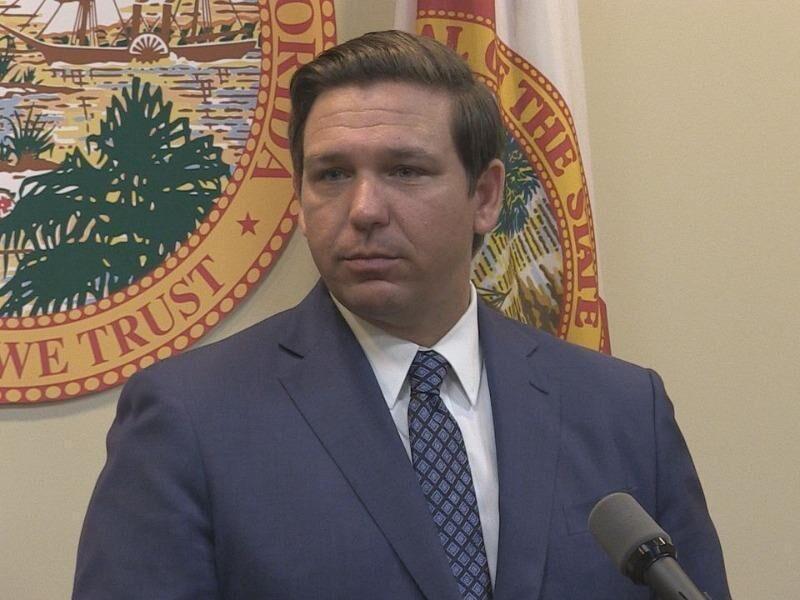
Late Wednesday, Gov. Ron DeSantis signed a $116.5 billion budget for the upcoming fiscal year, after vetoing close to $950 million in spending approved by lawmakers in March.
“Some of the stuff I don't think was appropriate for state tax dollars,” DeSantis said of the vetoes during a budget-signing event at The Vault, a venue in Tampa. “Some of the stuff you'll see are things that I support, but we have actual programs for.”
A wide range of groups, such as departments that oversee education, law enforcement, the departments of Transportation and Children and Families, agencies serving the disabled and the tourism industry, praised the budget for including money for their priorities. As examples, the Everglades Trust touted more than $740 million for Everglades restoration, the Florida Health Care Association pointed to an 8 percent increase in Medicaid funding for nursing homes, and the Florida Mosquito Control Association cited a $1 million increase in funding to “combat the world’s deadliest animal.”
Meanwhile, the progressive group DeSantis Watch called vetoes “cruel” and a demonstration of “misplaced priorities.”
The budget includes a nearly $1.8 billion increase in the Florida Education Finance Program, the main funding source for public schools, with total funding for the kindergarten through 12th-grade system topping $28.4 billion.
The overall pot of money for schools includes such things as a $20 million increase in mental-health funding and a $40 million boost for school-safety efforts.
DeSantis also approved a $200 million increase to help boost teacher salaries. Coupled with past increases, DeSantis said the budget will include $1.25 billion that can only be used to increase teacher salaries.
“No money to unions, no money to bureaucracy, only for teacher salary increases. And that's more than the state of Florida has ever done,” DeSantis said.
But the Florida Education Association teachers union said the money would have to be spread to roughly 200,000 educators and would not “move the needle” far enough.
“This $200 million equates to a salary increase in every classroom teacher’s paycheck of about $125 a month, and nowhere near the $15,000 annual increase needed to match the national average for teacher salaries,” FEA President Andrew Spar said. “The only thing the budget guarantees is that Florida’s teachers will remain near the bottom in average pay.”
Lawmakers passed the budget on March 8, the final day of this year’s legislative session. The state’s 2024-2025 fiscal year will start July 1.
In a 39-page veto letter, DeSantis touted the nearly $950 million that he carved out of the budget, but he did not include explanations for individual line-item vetoes.
“Governments should strive to do more with less,” DeSantis wrote. “It can be done, and my action today cements that lesson for the nation.”
Among the local programs DeSantis vetoed where a $500,000 instruction program for emergent bilingual students, a $250,000 Thacker Avenue improvement project in Kissimmee, $1.5 million for Phase 2 of St. Cloud’s proposed lakefront seaplane base, and funding for the Cross Prairie Parkway Connector and a $1 million UCF research project,
Numerous proposed education construction and renovation projects were among the items vetoed. Also among the vetoes was $80 million for the Florida College System to participate in the state group insurance program, which provides health insurance to state workers.
DeSantis said the vetoes will lead to total spending being below the current fiscal year, which will end June 30.
Among big-ticket items, the budget includes $14.5 billion for the state transportation work program and $232 million for cancer-research funding, including $127.5 million for the Casey DeSantis Cancer Research Program.
In addition to money in the budget, lawmakers also scattered about $1.95 billion in spending in separate bills. The budget is the only measure that has to pass each year, and DeSantis is still considering some bills from the session.
“I know we've got some more legislation that we're still processing, but I think this was the big enchilada that was left from the legislative session,” DeSantis said. “I'm glad we've got it done. I'm glad we've been able to meet the needs but also to keep spending under control.”