

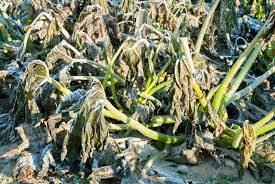
After some recent cool nights, there are some areas of our county expected to receive some frigid weather this weekend.
If you have some cold-sensitive plants, what do you do now? Is it best to cut the damaged plants back right away and begin to feed and water a lot?
Unfortunately, it is not yet spring, which means that it is indeed too early to try to revive your ailing plants. Just as the lawn needs to rest at this time of the year, the damaged plants need to do the same. The only thing helpful to do is to water them some. Fertilization still needs to wait until spring, as does pruning.
Why wouldn’t it be a good idea to tidy up your shrubs and trees to get rid of all of that ugly dead stuff ? It is for the same reason that you don’t prune them now anyway. This kind of treatment can encourage new growth, which will be more sensitive to cold and could possibly be damaged again. Fertilizer can have the same effect.
Another reason for leaving the ugly brown leaves and stems would be to provide the remaining parts of the plant with some natural cover to shield them from future freezes and frosts which could occur. Yes, this creates a rather unattractive look in your yard if you have very many damaged plants. But, if possible, it is best to try to ignore the spectacle until spring.
Fortunately, there is an alternative for a few non-shrubby plants which look particularly bad. Heliconia only blooms once per stalk, so if your plants already bloomed last year and weren’t cut back, now is the time. Mulch can be used to protect the roots. Most Ginger plants fall into that category as well. In this case, we can practice my favorite humorous sayings, spoken by gardening columnists Tom and Joani MacCubbin. “If you can’t stand the brown, prune it down.” This one is followed by, “When you can’t stand the black, hack it back.” And then there is always the fact that no one will arrest you for applying this practice to your shrubs too, but we all recommend waiting as the best choice.
Once spring arrives, you will be better able to tell which plant stems are actually dead, and which are alive. This will actually make your pruning project much easier. Often, the stems do not die immediately after a cold snap, but the damage progresses slowly over time. This means that you may have to prune multiple times as the stems continue to die, if you prune too soon.
If you have damaged palms, the same guidelines apply, except that you may want to use some copper fungicide, especially in the area of the bud and spear leaf. This can possibly prevent a secondary problem from fungi attacking the trees after the cold snap.
Do you want to learn more? Call our Plant Clinic at 321-697-3000 or email gardening questions to epabon5@ufl.edu. The Master Gardeners are hosting a Plant Market on Saturday, Feb. 25, at Osceola Heritage Park; at the market we are going to have plant vendors, classes, kid’s activities and more. Parking and admission to our Plant Market are free.