

Officials may vote to raise them within 90 days, citing 'extraordinary circumstances'

Watch the number of houses, businesses and other buildings are being built in Osceola County – they can be easily seen while waiting in traffic – and you know the county is growing extraordinarily.
At a workshop Monday to discuss proposed increases in fees assessed to new development, County Commissioner Ricky Booth put it succinctly.
“Take the Turnpike when you go home, and tell me this isn’t an extraordinary circumstance,” he told a consultant tasked with studying how much the county charges, if it should be more, and how fast.
It is that intensity of the moment, as the need for services and improvements outweighs the impact fees Osceola County and the City of St. Cloud are collecting, that is moving them to increase those fees – dramatically.
Impact fees, paid at the time a building permit is issued, are generally passed on from the builder or developer to the buyer. The one-time fee is paid to the county to maintain the same level of services, such as police and fire protection, medical services and transportation infrastructure. Residents also pay fees for fire protection out of their property taxes, “ad valorem” taxes that are based on a property’s value.
Osceola County discussed its plans and options to increase fees at the first of two workshops on Monday; the second is scheduled for this coming Monday at 1:30 p.m. The state mandates two such workshops must be offered to the public before a board can vote to put in immediate increases to address “extraordinary circumstances”. A vote on the increases is currently scheduled for July 1; the increases could not officially go into effect for 90 days after the vote. In this case, that would be October.
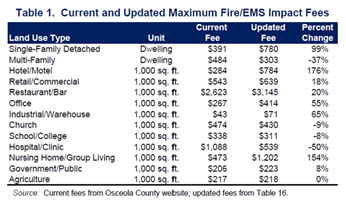
Two types of fees were discussed Monday: fire impact fees and mobility fees, and they pay for just what they say – fire protection and expansions related to roads. The state mandates any impact fee increase of 25% must be phased in over two years or 50% over four years, and fees can only be increased once in four years. And, by phasing in the fees, the county would actually receive less money in the first year, and see rates stay steady the next three years, before rates could jump in that fifth year.
That is, unless officials deem there are “extraordinary circumstances”. Factor in that Osceola County’s population is expected to nearly double by 2045 to 827,000, and that the cost of building a mile of road has increased from $3 million per mile in 2012 to $5 million in 2021 to $7.5 million in 2023, the ingredients are present for an emergency – that the fire department can’t fix.
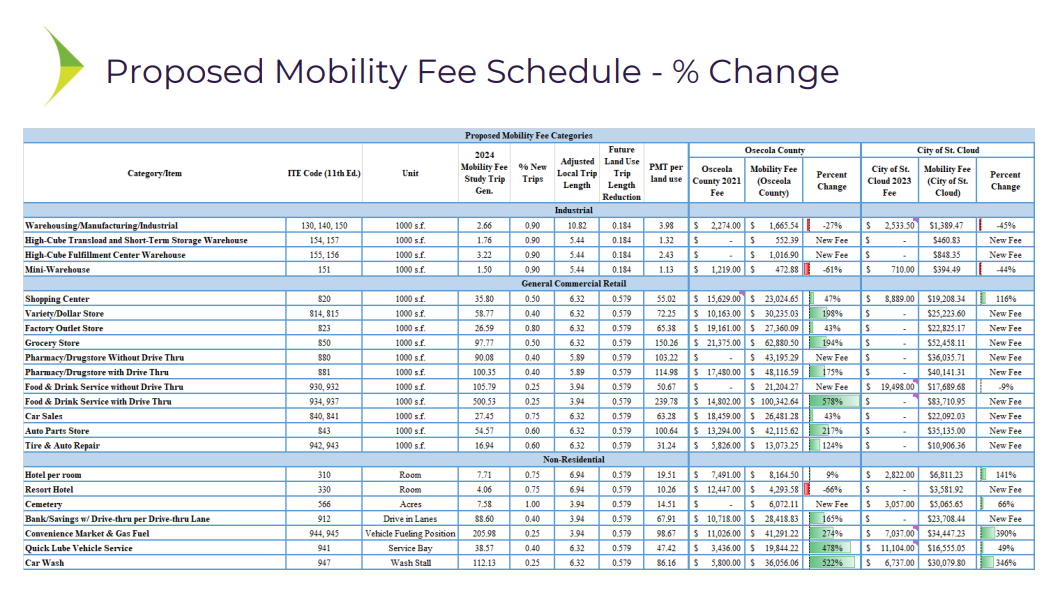
Under a proposal, tied to an equation that takes the land use into account, the county’s mobility fee on a single-family home would increase 150% from $10,000 to $25,012. In St. Cloud, the proposed rate would go from $6,442 to $20,866. Other land uses would see big jumps, like condos and apartments (129%), stand-alone grocery stores (tripling from $21,000 to $63,000) and pharmacies with a drive-through from $14,000 to a staggering $100,000.
The plan does include some decreases: a 10% drop in the county and 47% for fitness and athletic clubs, 8% and 29% for places of worship, and 50% for hospitals and clinics.
On July 1, the Board can vote to adopt the new fee structure, still adopt them at a lower rate, vote to phase them in over time, or leave them as is.
When Booth gave pause to making it harder for businesses to want to build in the county, County Manager Don Fisher said the county can’t “pick and choose” which categories to raise, per state statute, but can offer economic development incentives.
“I think we absolutely need to slow down residential construction. What we don’t need to slow down is commercial, industrial and employment center growth,” Booth said. “That’s the only that scares me. I hate beating this dead horse, but you’re exacerbating the issue by putting more houses on more land in an urban style without any commercial or employment center concurrent development. You’re actually it worse than what it’s intended to do. I hate we’re raising this for commercial because it’s not what we need.”
While the fire fee increases met with less opposition – county Fire Chief Larry Collier noted the county is building two new fire stations, rebuilding another, needs new equipment and to buy new land (which isn’t coming cheap) – developers and business advocates took issue with the speed in which the process is moving.
“We need more time to study this,” said local attorney Jo Thacker, who often represents development applicants. It took a year to study this, and now you want to vote on it in a month.”
A number of building and apartment developers also expressed a need for “more reasonable and predictable increases,” and The Osceola Chamber (of Commerce) also asked for time to conduct a peer review study for input from its members.