

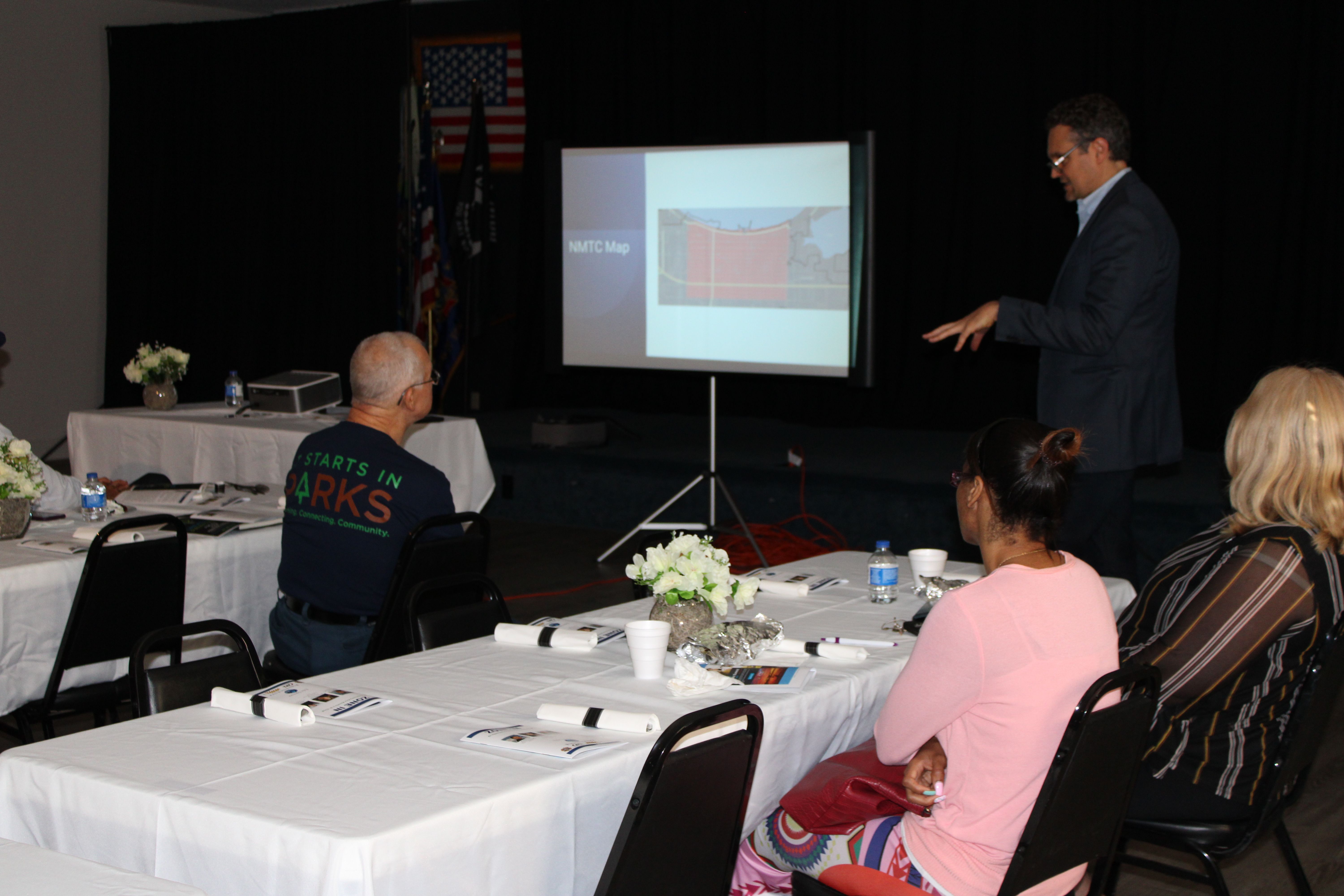
St. Cloud Main Street gathered business owners, realtors, and elected leaders to listen to Central Florida Opportunity Zone experts last week to learn about the intricacies of these federal and state programs, designed to incentivize business investment activity in economic-distressed locations.
Congress created the Opportunity Zone program in 2017 to provide tax incentives for long-term private sector development in low-income communities. The types of projects that can utilize the program’s benefits apply to most businesses and commercial development, but not residential development.
St. Cloud’s Opportunity Zone, as previously designated by the Governor’s office, is Census Tract 435, bounded by Kentucky Avenue on the west side, Mississippi Avenue on the east, Lakeshore Blvd. to the north and 17th Street to the south. It encompasses all of downtown St. Cloud and includes sections of the 13th Street corridor. It is one of five zones in Osceola County.
Opportunity Zone legal expert Roman Petra focused on the New Market Tax Credit (NMTC), an associated program created in 2000 for financial institutions that can be combined on projects in an Opportunity Zone.
“NMTCs basically means cheaper money or no interest ‘free’ money for project financing,” Petra said. “Utilization for this program in low in Florida, and other states have figured out how to revitalize whole portions of large cities using tools like NMTCs.”
Banking regulations require a certain level of investment in the local communities commercial banks serve, and programs such as NMTCs assist financial institutions to meet those requirements.
Both the NMTC and Opportunity Zone programs can be used for public/private partnerships, where cities and counties provide assets, such as land, for private development of needed and desired infrastructure. Donna Mackenzie, CEO of Bright Impact, a firm that assists investors and communities to utilize Opportunity Zones, made a presentation on opportunity zone financial and regulatory requirements. She emphasized that investors and other participants must “really follow the rules” contained in these performance-based programs. On the practical side, Mackenzie said: the zones are very good for attracting technology companies, given that their modest infrastructure requirements are usually a good fit with existing businesses and residents usually found in these zones.
The Main Street program concluded with a presentation by David Brindle, Business Navigator for the City of St. Cloud. Brindle outlined a new city software program where users can enter a property address and receive information on any and all zoning designations, overlays, or special districts that apply to the property. Opportunity zones will also be included in the software.
For more information on the St. Cloud Main Street program, see www.stcloudmainstreet.org