

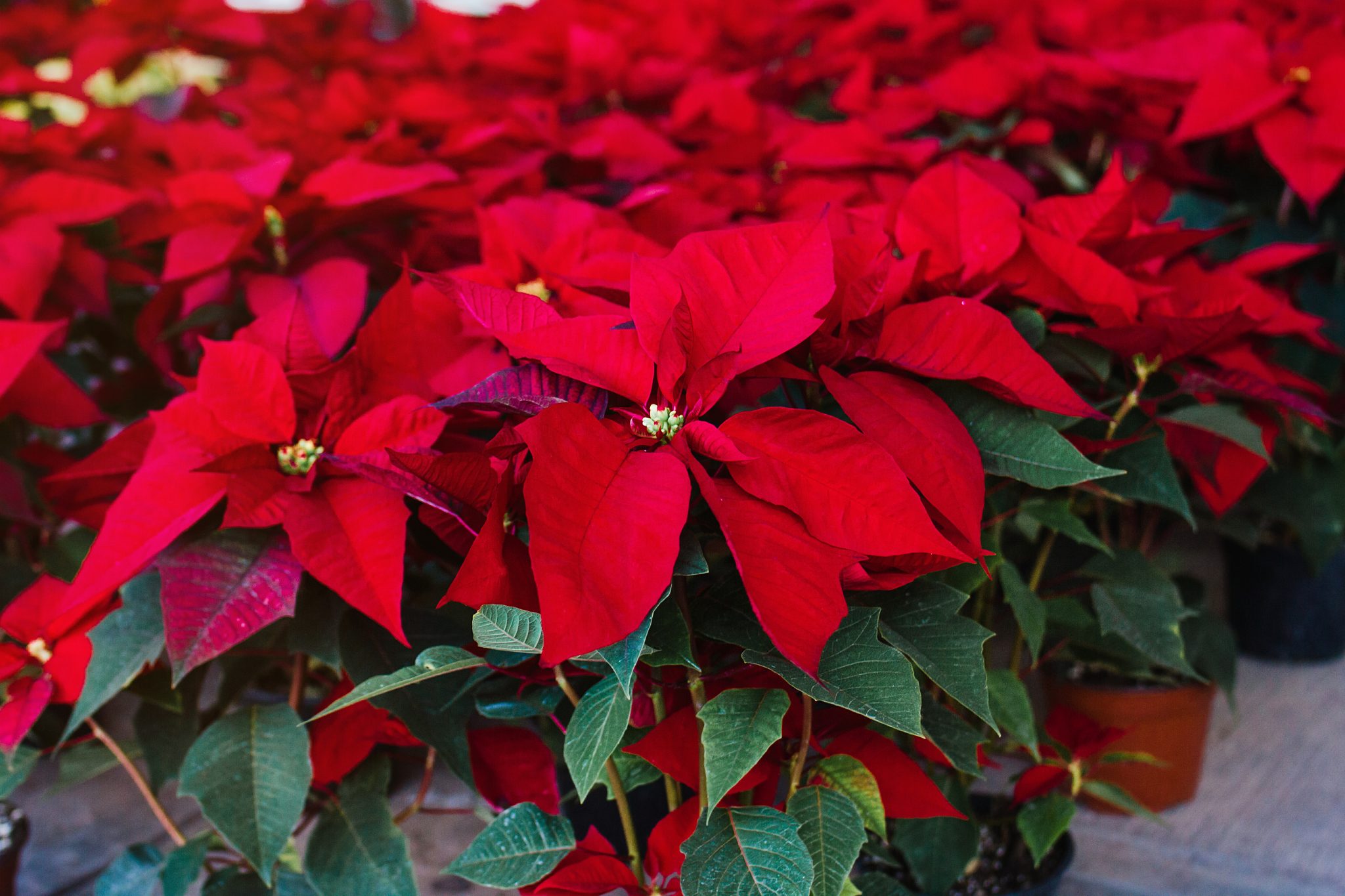
What would the holidays be like without poinsettias?
A native of Mexico, this beautiful plant was introduced to the U.S. in 1824. The large colorful bracts are actually not flowers, but modified leaves, which serve to attract pollinators to the tiny yellowish flowers in the center. The showy display can last through March with proper care.
Once you bring a new poinsettia home in a pot, the first thing to do is to remove the decorative plastic or foil wrap. It is not uncommon for roots to rot from standing water while in the wrap. If you have a plant with drooping leaves, it may already be too late. Also, dump water from saucers under the pots immediately after watering. Place the plant in a well-lighted area, and water only when the soil feels dry. A porch with full sun is perfect, as long as the plant is not subjected to freezing temperatures. Do not fertilize at this point.
By March 1, your poinsettia can be planted outside, though it will need protection from any late frosts or freezes. To help it adjust to its new situation, the pot can be temporarily placed in an area of partial sun. Next, find it a sunny location in moist but well drained soil. The preferable pH would be between 5.5 and 6.5. Your site must not receive any artificial light at night, which will interrupt the bloom cycle.
By Oct. 1, your plant needs about 14 hours of uninterrupted darkness per day. This means that it should not be planted near streetlights, security lights, flood lights, or under a window by the house. Even passing car headlights can aggravate the process. If conditions can’t be met, plants can be covered from 5 p.m. to 8 a.m. during the bloom setting period.
After planting, apply mulch, and water your poinsettia as needed. Fertilize with a slow release fertilizer and follow the directions on the label. Pruning may begin when flowers are faded and frost danger is over. New plants can be pruned to 12-18 inches from the ground. If plants are already smaller than that, stems can be taken to 4-6 inches from the ground. A pruning routine is necessary about once a month in order to prevent your plant from looking like a stick with few leaves. Prune new growth back to four leaves per stem each time the plant grows another 12 inches. For older established plants, prune off old blooms and about a third of total height. Then use the same procedure each time the plant grows 12 inches. Discontinue all pruning and feeding by October 1, since this is when flower buds begin to develop.
As for pests and diseases, watch for aphids, soft scales, whiteflies, and spider mites, and treat if necessary. The poinsettia hornworm can defoliate a plant, so watch and remove if present. Also watch for fungal spots which can appear on leaves. The worst problem facing a poinsettia would be root rot, from being too wet.
If unaffected by freezing, the poinsettia will become a large shrub. With proper pruning, it will be very thick, rather than tall and spindly.
Do you want to learn more? Call our Plant Clinic at 321-697-3000 or email gardening questions to epabon5@ufl.edu.
Extension Services will host a Plant Market on Saturday, Feb. 26 at Osceola Heritage Park; at the market we are going to have plant vendors, classes, kid’s activities and more. Parking and admission to our Plant Market are free.