

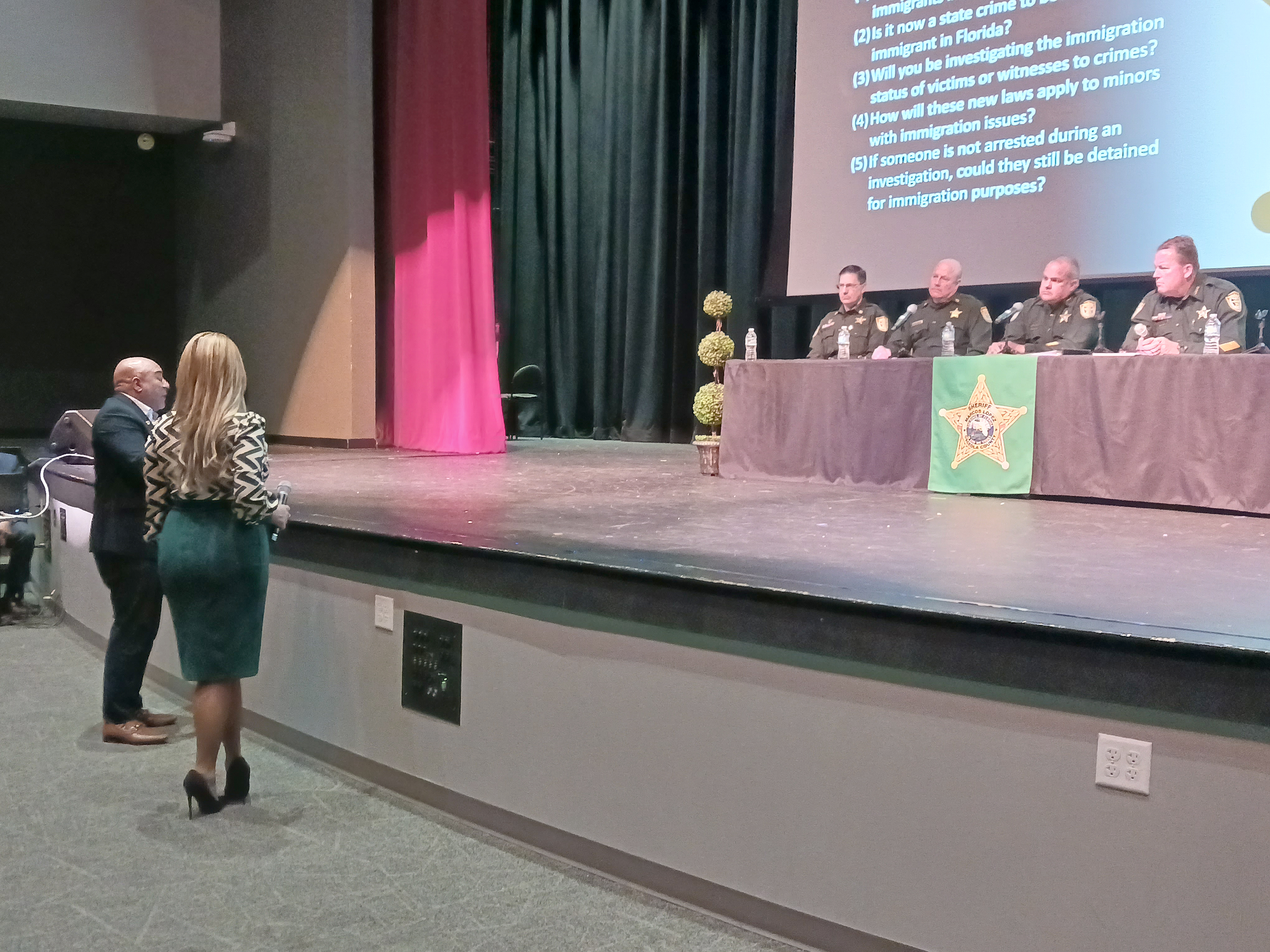
Sheriff Marcos Lopez assured a crowd at a Thursday town hall event that his department would treat the public fairly when implementing the state’s recently-passed immigration laws—which Gov. Ron DeSantis has called the toughest in the country.
At the event inside Gateway High School’s auditorium, attended largely by the press or groups of activists, Lopez went through a PowerPoint and outlined how law enforcement would work with Immigrations & Customs Enforcement (ICE) going forward after the bills were passed in February. The new laws are aimed at assisting President Donald Trump’s agenda of deporting undocumented immigrants. Lopez summarized some of the laws, which require law enforcement to cooperate with ICE and report any undocumented immigrants they encounter. Lopez reiterated that point throughout the evening, saying the department was committed to following the law to the letter.
Lopez said the new laws were “not about color, race or religion” of any residents of the area, saying Osceola County was “a large community with a large Hispanic population,” with “a lot of proud people who work hard.”
He asked for some patience from the public while his department adjusted to the new laws—part of the sweeping bills is funding from the state to train local law enforcement in how to enforce the laws.
He also stressed multiple times over the presentation that the Osceola County Sheriff’s Office wouldn’t conduct raids on schools, churches or other such places to make arrests. They’re just focusing on “the criminal element,” Lopez said, citing recent drug busts he said involved undocumented immigrants, along with some cases of undocumented individuals who had committed violent crimes.
“This country is law and order. I know a lot of people may agree or disagree with some laws that are passed, but as a constitutional officer, I follow the law,” Lopez said.
He peppered that with assurances to the community, saying victims of crime who happened to be undocumented immigrants would not be targeted.
“If you’re a victim, we want to help you, especially if you have a child,” he said.
“People say ‘I’m afraid to come forward, I’m about to probably be deported on the spot,’” Chief Deputy Maj. Dan Weis said. “We’re not going to do that. We’re after the criminals.”
After the presentation, the sheriff took questions from the crowd. One audience member asked what the department would do if they came across a family where their documentation status was mixed—if some were undocumented but others had proper legal documentation. Lopez said every circumstance was different, though they would have to notify ICE of those undocumented.
Another attendee asked what they would do if they found someone who was taking care of a young child or a minor who was undocumented. Lopez said that would involve a “navigation” of the federal system, but that the sheriff’s department would still be focused on “the criminal element” foremost.
Jorge Figueroa, president of the Puerto Rican Chamber of Commerce of Central Florida, asked what would happen in cases where law enforcement wanted to enter a business. “If I don’t allow them, am I committing a crime?”
Lopez said his advice in that regard was “cooperate with law enforcement.”
“If you’re not doing anything wrong, they’re not showing up at your business just to show up at your business,” he said.
Following the event, Figueroa said he came to the event representing members of the community who were “very concerned” about the new laws, some of them business owners.
“Some have lost workforces,” he said. “We need to be aware of how law enforcement takes part. We want to make sure we feel that law enforcement is protecting our rights.”
Maria Revelles, co-director of La Mesa Boricua de Florida, a grassroots organization working to “strengthen the power and well-being of Puerto Ricans everywhere,” said she wanted to know how is Osceola County going to implement the law.
“We wanted to hear it straight from the sheriff,” she said. “It wasn’t clear how he was going to implement the law. They said ‘we’re not trained,’ ‘we’re helping’… what does helping mean?”
Still Revelles said she came away pleased.
“We applaud Sheriff Lopez for dealing with transparency and honesty,” she said. “We heard things we like—they talked about ‘humane’ and ‘protecting victims.’”