

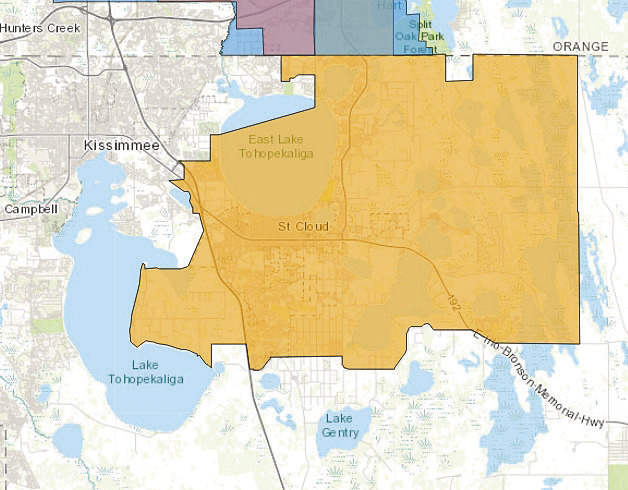
The Orlando Utilities Commission, which provides electricity to customers in St. Cloud, the Narcoossee Road area, points farther east and some portions of Osceola County bordering Orange County is implementing a new Demand Pricing program. New rates for users in November will be based on “peak demand” from individual usage in October and will continue to change month to month with a three-tiered “demand charge.”
After a 12.5% reduction in kilowatt-hour rates, residential and small commercial customers’ new rates will be based on a three-tiered Demand Level usage charge, ranging from $5-15, based on the highest 15-minute average use period during the previous month. According to OUC, the tiers rebalance costs and reflect individual customers’ usage of the electric grid. OUC’s stated purpose is to have customers shift demand from peak to off-peak periods, to help to reduce the need for huge capacity additions.
This goal seems at odds with previous public statements by a senior OUC representative, who, as stated in February 2025 at a St. Cloud economic forum, that OUC was well situated with excess, economical power generation capacity, a major attraction to high-tech industries. Conversely, as many OUC customers may recall, during the unusual freezing weather snap in February 2026, OUC was urgently warning residents, by text alerts and other communications, to conserve energy. Both residential and business customers were asked to take steps to reduce electricity usage from 6-9 a.m. for several days. The requests to conserve electricity included delaying the use of appliances and machinery until later in the day, and for businesses to consider adjusting work hours and implementing remote work to reduce electricity use during the peak morning hours.
Despite several requests for comment, an OUC spokesperson simply relayed that OUC has sufficient capacity to provide customers with economical power for the foreseeable future. At the same time, OUC’s mandatory 2026 Ten-Year Site Plan filing with the Florida Public Service Commission indicated a reduction in OUC’s own capability to produce electricity, with an increasing reliance on importing electricity, termed “Import Capacity.”
Under a federal mandate, OUC’s long-running Stanton Unit 1 coal-fired generating plant was required to stay online until Sept. 1, 2026, due to regional electricity supply concerns, despite OUC’s original intent to retire the plant in 2025.
Now, through at least 2035, OUC’s own capacity to produce electricity will remain constant at 1556 megawatts (MWs). During peak Summer demand, OUC projects it will need to “import” increasing amounts of power, by up to 1700 MWs in 2035, basically triple the 2026 import amount of 584 megawatts. Winter peak demand import levels in 2034 are projected at 819 Megawatts, basically double the current 2026 amount. This leads to a question of how dependable future Import Capacity sources will be, especially in statewide and regional weather or worldwide geopolitical events.
As OUC customers have become increasingly aware of the new pricing structure, concerns are being raised. Comments on social media include how working families do not have much flexibility as to when household chores requiring electricity, such as washing clothes and vacuuming, can be done. Some business owners also cite their inability to adjust usage, based on their customers’ demands that dictate operating hours and utility consumption. Owners of electric vehicles have expressed concerns that their decision to own an EV, long incentivized by various levels of government to reduce carbon pollution, will now face increased electricity rates caused by their need to recharge their vehicles at home.
For more information on OUC’s Demand Level pricing plan, see https://bit.ly/4yIiXuE.