

Plans include former golf course land
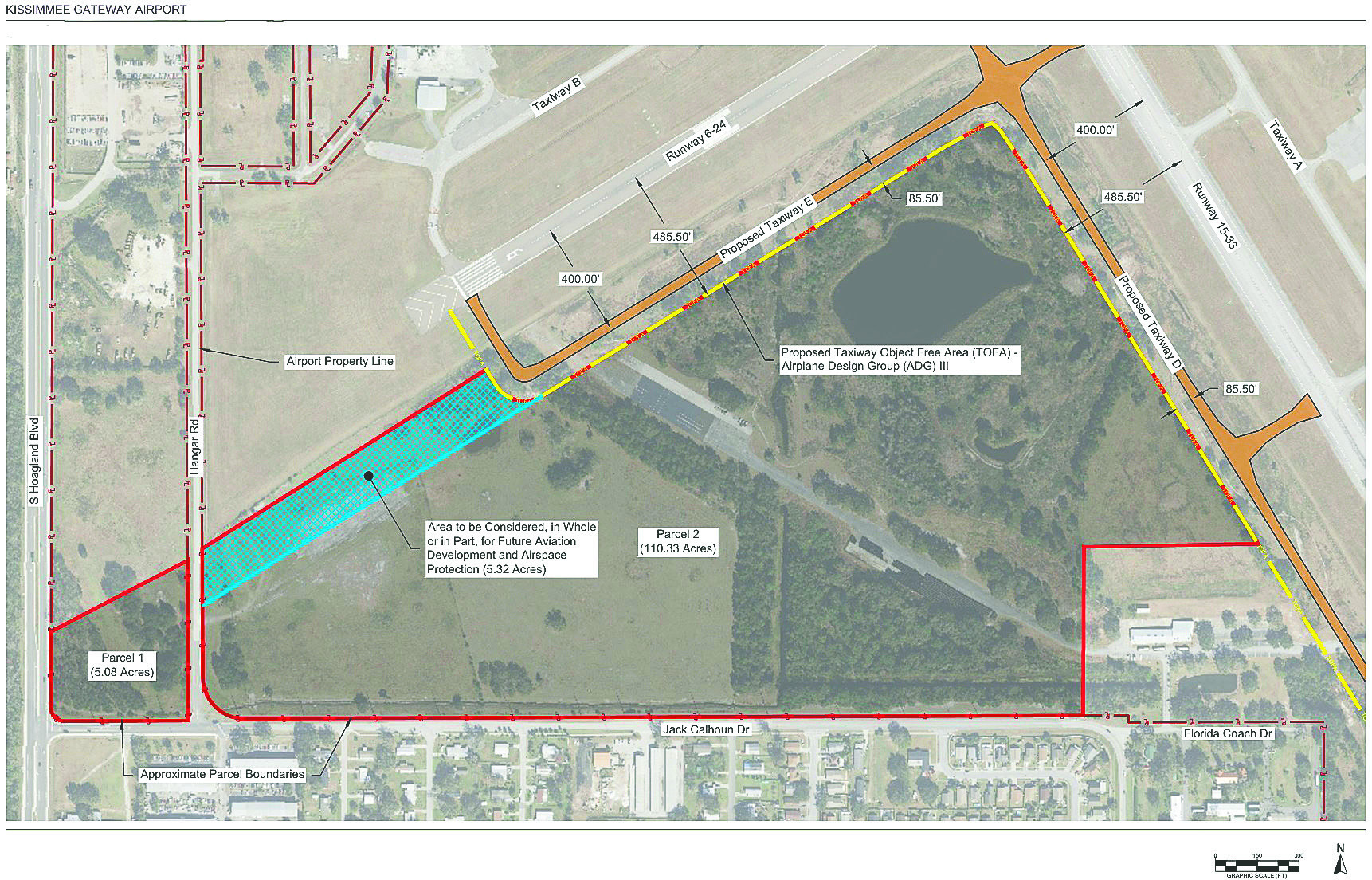
After completing a Memorandum of Understanding with the Kissimmee Airport Development Company in November 2025, the City of Kissimmee approved a Term Sheet with the company at the Oct. 6 Commission meeting. The Term Sheet outlines specifics for types of development, timelines, and performance milestones.
“We are really looking to develop this property to have the greatest amount of economic development and job creation for the community,” said Shaun Germolous, the city’s Director of Aviation.
At 110 acres, the southwest quadrant of the airport, outlined by South Hoagland Boulevard and Jack Calhoun Drive, represents the largest open tract of airport property available for development, and includes the former Kissimmee Golf Club that closed in 2018. Development is intended to take place in three phases.
“We are hoping that Phase One will consist of a row of 30,000 square foot hangars, which would then be the largest hangars on the airport,” said Germolus.
Federal Aviation Administration grant restrictions, incurred each time the city/airport accepts federal grants, require that the airport utilize its property for aviation uses to the maximum extent possible. Any proposed development in the southwest quadrant will likely correspond with the airport’s current master plan, which was reviewed and accepted by both the FAA and the Florida Department of Transportation in 2022. Some airport property fronting Jack Calhoun Drive and Hoagland Boulevard may be developed for nonaviation commercial or industrial use.
Now that the city commission has approved the Term Sheet, Kissimmee Airport Development Company can actively market the airport property to future aviation business users while a lease agreement is being finalized.
“We are waiting on the lease agreement so we can pursue Letters of Intent (LOIs) we have been negotiating over the last six months,” said Hector Lizasuain, CEO of Kissimmee Airport Development Kissimmee Airport Development Company.
According to the Term Sheet, substantial completion of development in a phase will trigger the opportunity to begin development of the next phase. Phase One will cover approximately 25 acres and requires the construction of a minimum of $25 million in infrastructure and facilities. A future Phase Two will consist of 45 acres, and the final Phase Three would be 30 acres. A tentative lease rate of approximately $9,000 per acre has been established; however, rent payments would not start until a facility has been constructed and receives a Certificate of Occupancy from the city’s building department.
At this time, portions of the Phase Three property, east of Hoagland Boulevard, is envisioned as a vertiport, to support Advance Urban Mobility vertical take-off and landing “air taxis.” Since these types of aircraft operate similar to helicopters, siting a vertiport in the same vicinity as the current MaxFlight Helicopter Services, which operates aerial tours and helicopter flight training at their 4th Street facility, makes operational sense for air traffic control purposes. In July, Orlando International Airport announced plans for a landing site for electric vertical takeoff and landing (eVTOL) aircraft near the Brightline train terminal, with potential commercial operations starting by 2030.
For more information on the Kissimmee Airport, see https://bit.ly/3XnkC8l.