
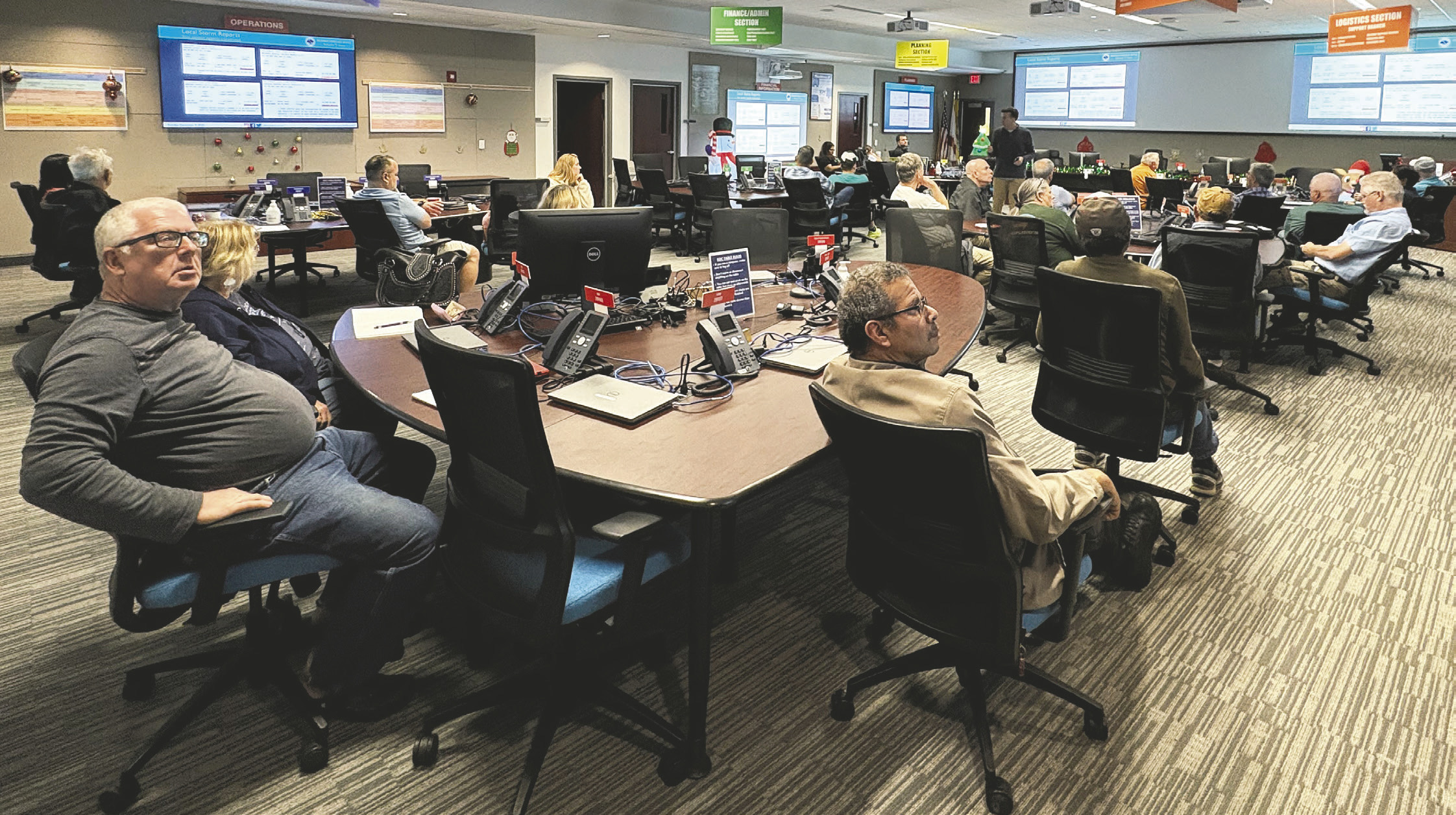
Last week, over 20 residents spent two hours learning what it takes to become a SKYWARN spotter for the National Weather Service. Spotters provide essential information for all types of weather hazards, with the focus on reporting the strength and impacts of severe local thunderstorms here in Central Florida.
“Our radars, sensors, and instruments can only tell us so much, so we rely on our network of SKYWARN spotters to help establish and verify hazardous weather, including high winds, hail, flooding, and funnel clouds or tornadoes,” said Will Ulrich, Warning Coordination Meteorologist for the National Weather Service (NWS) office in Melbourne, who conducted the training.
There are currently 150 trained SKYWARN spotters across Osceola County, and over 1800 in total across the counties covered by NWS Melbourne, from Volusia County to Martin County along the coast and four adjacent inland counties, including Osceola. A comprehensive network of spotters enables NWS to issue more timely and accurate warnings for weather hazards. Classes are held at least once per year per county and must be retaken every three years to maintain certification.
Back in September, an Osceola-based spotter reported a funnel cloud over East Lake Toho, and in August, a brief tornado was spotted on Nova Road approximately 3.5 miles away from U.S. Highway 192.
The training included the basics of thunderstorm development and structure, how to identify potential severe weather features, what information to report, and last but not least, severe weather safety. Participants were introduced to the ACES concept, which stands for Awareness, Communication, Escape Routes, and Safe Zones, for use whenever engaged in storm spotting.
“Don’t be storm chasers and always keep aware of the conditions around you when observing weather events, and please never expose yourself to potential harm,” said Ulrich.
After completing the training, spotters are issued an identification number and given access to the digital Weather Spotters Field Guide, including a mobile version.
Osceola County Emergency Management Director Bill Litton said the program is a requirement for the county’s ‘Storm Ready’ certification it’s earned with the NWS.
“Plus, it gives the NWS in Melbourne additional spotters to rely on where there are storm conditions,” Litton said.
Several residents attending the Tuesday evening training are members of Osceola Amateur Emergency Services, who combine their interest and expertise in Ham radio to provide a reliable Amateur Radio communications support component to the Osceola County Office of Emergency Management, as well as other community service activities, such as participating in SKYWARN. HAM radio can become the only sure means of communication when there is severe damage to infrastructure and no electricity. The group will be conducting a field exercise in January.
There are also other ways the public can help the National Weather Service. The Citizen Weather Observer Program enables people with computerized weather stations to send their weather information to a special data server that collects weather observations from around the country. Another opportunity is the Community Collaborative Rain, Hail and Snow Network, where volunteers use low-cost measurement tools, such as rain gauges, combined with rigorous training to collect valid measurements for natural resources, education, and research applications.
For more information on the National Weather Service’s SKYWARN program, see https://bit.ly/457hoKv.