

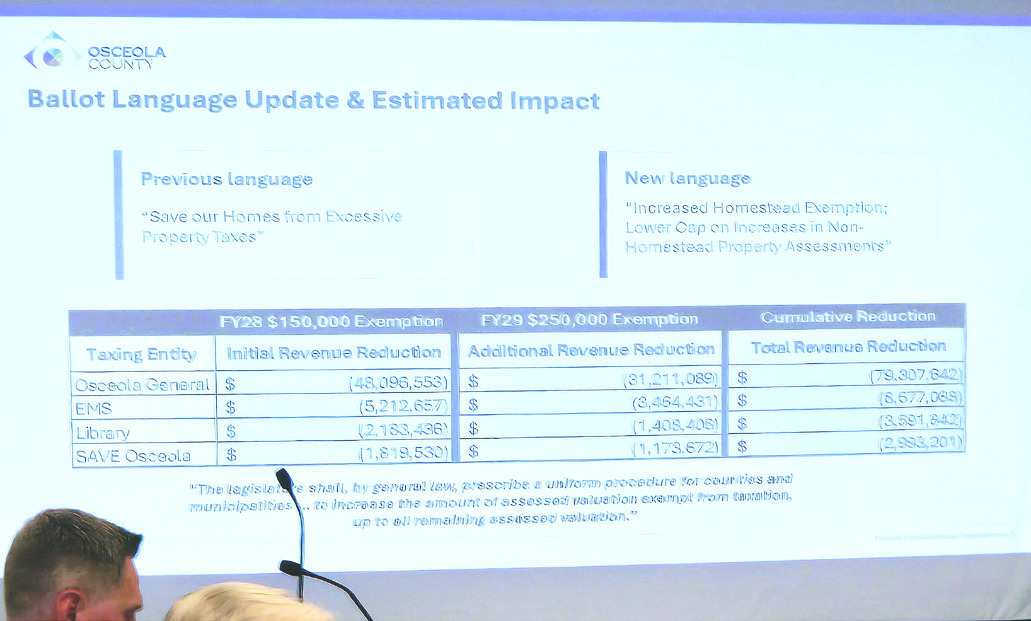
County: Measure to increase exemption, lower property taxes would have $79M impact over two years
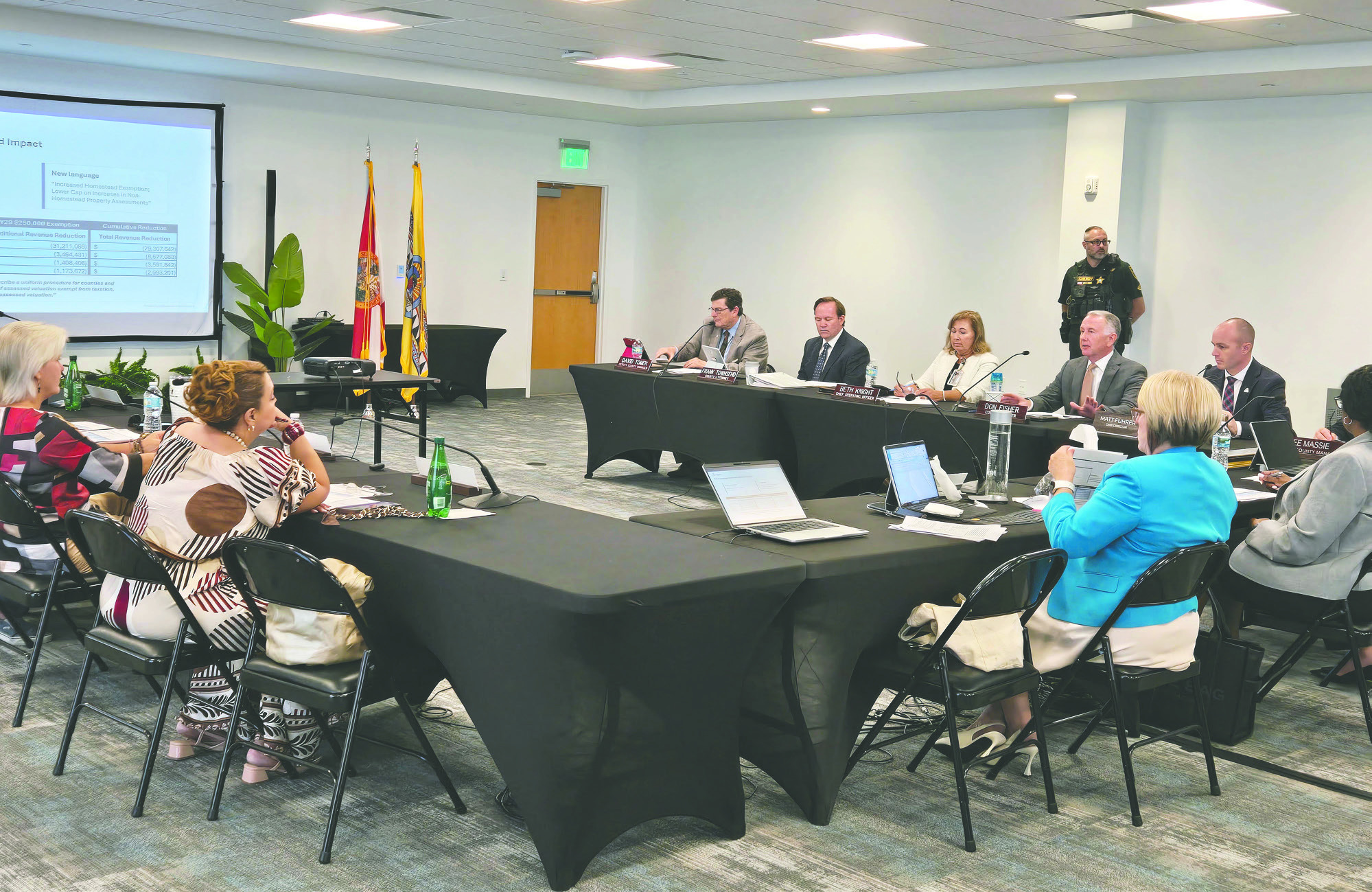
Without a Commission meeting Monday, Osceola County leaders took to NeoCity for a discussion on the proposed changes to its budget should Amendment 3, a state charter amendment, get 60% of statewide votes in the Nov. 3 election.
If passed, the amendment would raise the standard homestead exemption on primary residences from $25,000 or $50,000 to $150,000 in Fiscal Year 2027-28 and $250,000 in 2028-29, and would define how local governments can allot some funding regarding first responders.
Much of the talk Monday was dire. “It is a traumatic episode that we’re looking at. I was elected in 2008 when the Great Recession happened, so I’m very familiar with local government being broke,” County Commission Chairman Brandon Arrington said. “And if Amendment 3 passes, that’s exactly what will happen once again, we’ll have to look at cuts to public safety.”
With an expected impact of $79 million to county revenue over the next two years, the county shared many of the cuts planned to save money over that time—but the county’s only identified $70 million in cuts.
“It’s a start to position the county,” County Manager Don Fisher said. “We’re still short … we want to do it now rather than when it’s mandated.
“This is the start of many possible cuts we need to make. While it may make Florida remarkably attractive without homestead property taxes, the impact of services required won’t cover the limited funds that come in. There will be a shift of the burden to non-homesteaded properties.”
Commissioners predicted a conundrum for Osceola County: those who own commercial properties or vacation homes, who do not qualify for a homestead exemption, will be asked to pay more, but will receive fewer services.
“We’re forced to build a house, but no one is forced to build a road?” Commissioner Ricky Booth asked. “We have to work our what our legal pathways are to shutting down future housing developments, or else we’ll be spending resources to fight to just say no to new residential developments.”
Booth said the expanded road projects drivers are now seeing, like on Neptune Road, Partin Settlement Road, Simpson Road and Poinciana Boulevard—wide lanes with raised grass medians, sidewalks and upgraded drainage—may be a thing of the past.
“Dig a ditch and paint a white line on the right side; that’s about all we’ll be able to do,” Booth said.
Matt Fuhrer, the county’s Director of the Office of Management and Budget, noted that the county’s mobility fees, paid by developers who build projects that create an impact on the county’s roads, are the highest in the state.
“But they’re still not enough to cover the road projects necessary to keep up with growth,” he said.
As part of Monday’s presentation, county officials shared its five-pronged “reduction philosophy” to making needed cuts: Identifying mandated services; Consolidating and deferring costs; Identifying cost recovery (balancing user-fee based services that things like permits pay for, and what’s recovered; Reducing levels of service; Eliminating projects and activities, which would include cutting funding to groups like Kissimmee Main Street, the UCF Business Incubator and memberships to area Chambers of Commerce.
For example, those grass medians on the new roads may not have anyone to mow or maintain them come October 2027, when the first fiscal year with the new homestead exemption rules begins. Arrington spoke of other responses Monday.
“I’m looking at elimination of a fire station and actually taking another truck out of an existing fire station, getting rid of our school resource officers that we help,” he said. “Providing funding to our school district so that that would be something else that would go away, if this passes and of course, we’ll have to have continued talks with our Sheriff over their budget, because it’s about 50% of the overall county budget is the Sheriff ’s budget as well. So there will have to be cuts.
“Currently in Osceola County we have about a 24-hour response time on a pothole. Instead, you could be looking at a four-month to maybe a 24-month response time to fix those problems. We also have to take on the contract from the state of Florida for SunRail, and I don’t know how any local government is going to be able to take on those extra million dollars of cost.”
But, some in the community aren’t buying it. John Kalish of St. Cloud has been very vocal on social media about how Amendment 3 will force governments to budget soundly.
“Property tax revenue increased 54 percent from 201925, but the county population only grew 26 percent,” he said. “This $79 million is just a small percentage of a $3 billion budget.”
He said spending and salaries have soared on the backs of homeowners, even those who own their homes outright.
“It’s always been on the homeowner to figure it out. Using our homes as an ATM is over,” Kalish said. “It’s about time the county figures it out.
“A $50,000 homestead exemption is worth about $22,000. It’s about a third of the median house price. When those were first put in local governments predicted the same gloom and doom they’re predicting now. Those exemptions never kept up with inflation.”
With exactly two months until the Nov. 3 election when Floridians will decide whether to accept Amendment 3, expect to hear much more about it from those with the most at stake.
“Our county attorney is going to be working with our communications team to make sure we follow the laws that are set forth by the state of Florida. (State leaders) have put restrictive language on local governments on how they can go out into the community. “It’s more creating awareness and it’s not really pushing a narrative of vote forward.”