

As America prepares to celebrate its 250th “birthday” this weekend, celebrations will be taking place in all the familiar sites associated with the Revolutionary War, including New England, Philadelphia, and Charleston, South Carolina. Not often considered is what was happening in Florida during the time of the birth of our nation.
For us here in Central Florida, the popular perception of the “history “of the region really does not start until after the Civil War, when pioneer families came into the area from war-ravaged Southern states such as Georgia and Alabama. However, for a brief period in the colonial era, from 1763-83, British East Florida was a “14th colony” and played a part in the war for American independence.
Britain’s victory in the 1763 French and Indian War, part of the global Seven Years’ War against France and Spain, was also fought by American colonial militias from Britain’s thirteen colonies.
In the “horse-trading” that happened in the treaty that ended the war, France was forced to give up Canada, and Spain gave up its long-held territory in Florida.
Not surprisingly, St.
Augustine became the capital of British East Florida, and the city’s familiar Castillo de San Marcos was renamed Fort St. Marks. Likely, the closest development to Osceola County at that time was the establishment of the Turnbull Plantation in New Smyrna Beach. Founded in 1768 by Andrew Turnbull, Mediterranean indentured laborers and enslaved Africans worked the largescale agricultural settlement.
The plantation ultimately failed after nearly a decade due to harsh conditions, such as yellow fever epidemics, and mismanagement.
Just one month after the signing of the Declaration of Independence on July 4, 1776, American forces from Savannah, Georgia, unsuccessfully attempted to capture St. Augustine. A second attempt came in May 1777, when a Continental Army flotilla and Georgia militia cavalry crossed the St.
Mary’s River but were ambushed at Thomas Creek, near presentday Jacksonville, by a combined force of British militia cavalry-the East Florida Rangers, and Muscogee (Creek) Native American allies, forcing a retreat back to Georgia. Finally, in June 1778, another combined Continental flotilla and overland force again tried to capture St. Augustine but were repulsed during a battle at Alligator Bridge, near present-day Callahan, Florida. While the aggressive American campaigns in Florida were unsuccessful, they did forestall British attempts to retake the Georgia colony until 1780, when the British shifted their offensive focus to the former southern colonies, including the Carolinas and Virginia, and ultimately retook Georgia.
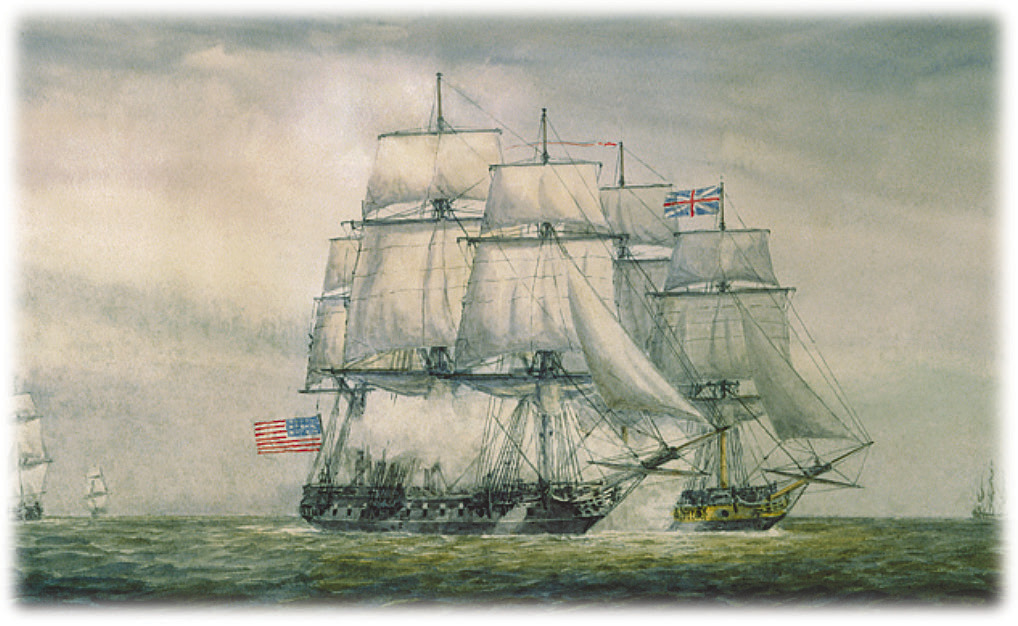
Several naval actions took place in Florida waters during the war, with the most notable naval engagement occurring on March 10, 1783, off Cape Canaveral in Brevard County. Two U.S.
Navy ships, traveling north from Havana, Cuba, and carrying a precious cargo of 72,000 Spanish silver dollars, encountered three British Royal Navy ships traveling south. When the largest American warship, the frigate U.S.S. Alliance, defeated the Royal Navy frigate HMS Sybil, the British force broke off. This was to be the last naval battle of the Revolutionary War. In more “horse trading” in the 1783 Treaty of Paris that ended the Revolutionary War, Britain surrendered its interests in Florida back to Spain in return for control of the Bahamas.