

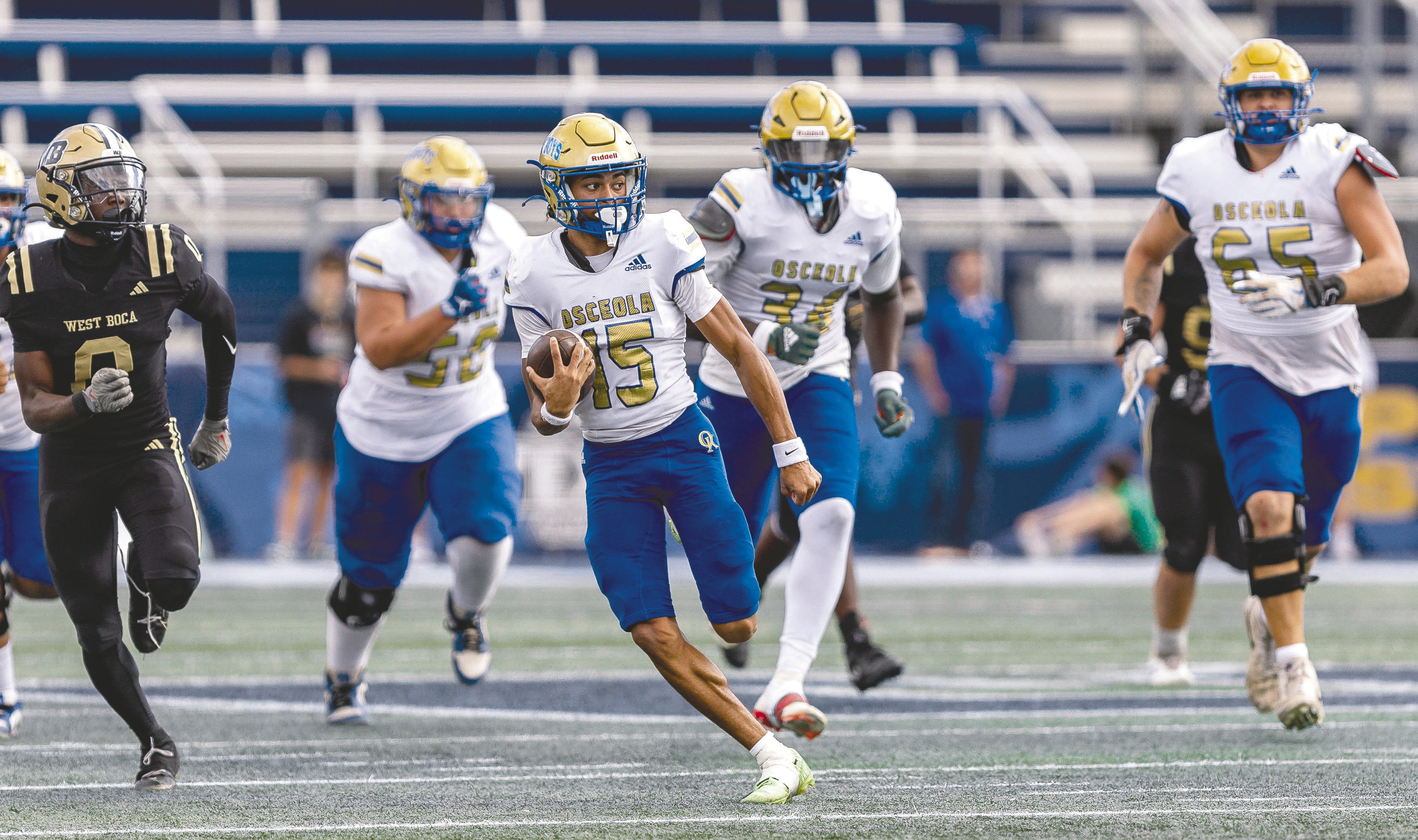
If you think college athletics is out of control with its transfer portal, you might want to start paying attention to your local high school—where school choice rules may have made player movement even more prevalent than the college game.
When the high school football season kicks off next week, at least three-dozen players—a number that seems to swell with each passing year—will be wearing different uniforms than a year ago.
“It really is the ‘Wild, Wild West,’” Osceola Coach Eric Pinellas said. “But it’s also the world we live in right now, so you have to learn to adapt.”
Prior rules made out-of-zone transfers more difficult and transparent—requests were often scrutinized by the FHSAA; with denials or ineligibility rulings common.
But after “school choice” legislation was passed years ago in Tallahassee, transfer requests were essentially rubber-stamped provided there was a student station available and the student could provide transportation to their new school.
According to some local coaches, what started as a trickle has become a raging torrent as the number of transfers for athletic purposes has risen dramatically in recent years.
While this free movement became most notable in the sports of football and basketball, but it has had an impact on almost all sports. Pinellas said four underclassmen starters or potential starters from his 2024 state runner-up team informed him they were transferring; while five key players of St. Cloud’s 2024-25 OBC championship basketball team have indicated they would be playing elsewhere next winter.
It’s a story playing out statewide—the Fort Myers News Press recently reported on the “Southwest Florida High School Transfer Portal,” listing 50 prominent area players finding new area schools in the off-season. Bishop Verot and First Baptist schools alone combined for 24 incoming or outgoing transfers.
“As coaches, one of our missions is to build character and teach our athletes how to deal with adversity,” Harmony Coach Don Simon said. “Today, if they are faced with some competition for playing time, they just want to take the easy way out. More importantly, it is truly taking the sense of community and school spirit out of the game. Kids who grew up next to each other and played sports together for years are getting split up when one moves to another high school. When it happens enough there is no longer a school spirit of ‘we’ or ‘us,’ it just becomes about the “me.” I think it’s really sad.”
Pinellas named a multitude of reasons for this movement.
“You simply can’t point to one thing or blame one reason. Social media, travel ball and camps, the desire to play varsity at a young age, the influence of parents and relatives, and yes, coaches recruiting outside the rules, can all be factors,” he said. “(Social media has shrunk the world. These kids are all in constant communication. They all know each other … it’s easy to talk to another player and tell him they should join forces on the same team.”
The emergence of specialty camps and travel teams is also a major factor in the transfer boom.
“These athletes may be high school rivals, but they end up playing together at camps and on 7-on-7 teams in the summer,” Pinellas said. “The players talk, they end up recruiting each other; not to mention it gives the coaches of these summer teams access to your players.”
The desire to play varsity at an early age also factors in, coaches say.
“It wasn’t that long ago, kids knew they were going to play freshmen or junior varsity football and if they had enough talent, they might have a chance to play varsity as a sophomore or junior,” Simon said. “That understanding is long gone. Guys get impatient and want to play immediately and if it looks like they are going to have to wait a year or two, they simply decide to leave and play somewhere else.”
“Some athletes want to start getting game film early for college recruiting and are almost demanding playing time early,” Pinellas said. “If you can’t promise playing time to some of them, they simply are going to find another school that can make them that promise. It makes it hard to develop players.”
In theory, this need for playing time may help some lesser programs gain talent, it really doesn’t work that way. Athletes looking for playing time will often select a winning school that has a particular need at their specific position.
“Over the years, we may have had a kid or two transfer in just for playing time but it rare,” Gateway coach Marlin Roberts, whose teams have equally seen struggles and success in his 16 years at GHS. “But I can promise you that we have lost a lot more kids that were zoned for Gateway, shown some talent early, and then were convinced to play elsewhere.”
First year Liberty head coach Janko Beras knows that all too well—eight experienced Charger players will play elsewhere this fall, he said.
“It’s like everyone is looking for a better deal. In the long run, it’s not good for the individual because it doesn’t teach them to deal with challenges and adversity. Sometime later in life they are not going to be able to just run away from their problem,” Beras said. “This transfer thing sort of defeats the purpose of what athletics are supposed to teach.”
The real winners in the transfer game seem to be elite public and private school programs, attracting the best players like the wealthiest universities.
“One team that wins a state championship, graduates 18 starters and the next year seems to have 18 new players just as good, and more than half of them are transfers,” Pinellas said. “There’s no way to really compete with that.”
Former Osceola Athletic Director Rick Tribit once noted this new transfer window is more than a two-way street and is seldom equitable.
“We had a couple of highprofile kids transfer to our football program and I heard some rumblings about how and why that happened, but what I can tell you for sure is, while I was AD I signed a lot more paperwork for kids transferring out of our program than I did for ones tranferring in.”
While there are still rules in place that prohibit coaches from recruiting, Pinellas says those rules are usually ineffective, seldom investigated and mostly unreported.
“The coaches that do it are usually smart enough to not get caught doing it by using intermediaries and people not officially associated with the program to make the contacts,” he said. “The FHSAA does not accept anonymous reports of violations. Coaching football is intense and time-consuming to begin with; why waste the time and effort to police other programs?”
Parents and relatives play into the process. Often that influence comes in the form of a parent’s “Little League mentality” of “My kid’s the best and should be starting.”
“Right or wrong, a parent or relative will get into an ear of their kid and suggest he needs to move on,” Pinellas said. “Sometimes you wonder about the motive, but I would never suggest a coach should have more influence over a kid than his parents have.
“You have to pay attention to your players and have almost daily or weekly contact with them during the offseason, because if you don’t you are going to be the last to know that a player is leaving. We had an athlete who came in, started our spring game, and participated in some offseason workouts. Next thing I know his dad calls me the first week of summer and says he’s transferring to another school. It happens that fast.”
St. Cloud Coach Michael Short says the player transfer issues have driven many coaches to their breaking point.
“To tell you the truth, I think most of us liked it better under the old system where you had to jump through hoops to accept transfers. I think there was a much better sense of community when you attend the school you were zoned for,” Short said. “I know the current situation is driving some good coaches out of the business. Seven coaches I know from Orange County simply quit in the last year or two, citing the current atmosphere of high school football.”
It has become so wide open that some athletes have been known to transfer, play football at one school, and then transfer back to play a spring sport at their original school, and some, transfer in and transfer out again before ever playing a regular season varsity game. The situation gets more complicated as a new law permits homeschooled students to play at any county school they choose.
Short of any new rules, Pinellas says he and his coaching colleagues have just learned to adapt. “When I was an assistant under Doug Nichols, he said something that resonates with me to this day: we are never going to worry about who decides to leave, who decides to stay or who decides whether they want to come here; our focus is only going to be on the kids currently here who want to be here.”
Veteran Tohopekaliga Coach Anthony Paradiso is also philosophical about the issue. “We gain players, we lose players, it’s simply the way it is—and in all honesty transfers have always happened. You just hear a lot more about it today,” he said. “I want to coach kids that want to be here. If he wants to play elsewhere, then we thank them for their efforts while they were here, wish them well, and part ways.”
“As distasteful as I find the situation, we, as coaches, can’t do a thing about it,” Simon added. “Open transfer is state law. I am not sure whether anything can be done to at least partially get this thing back on the rails. As a coach, your choice right now is to adapt or quit.”