

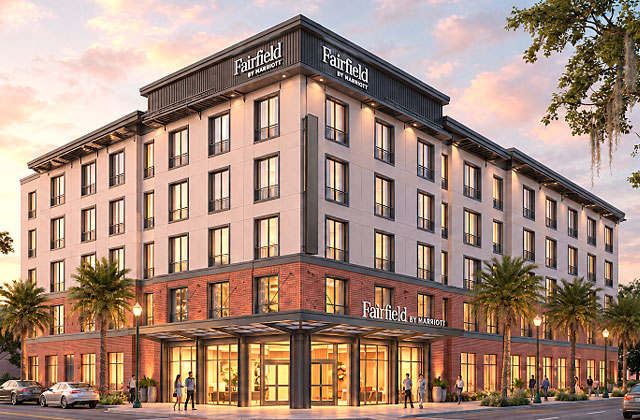
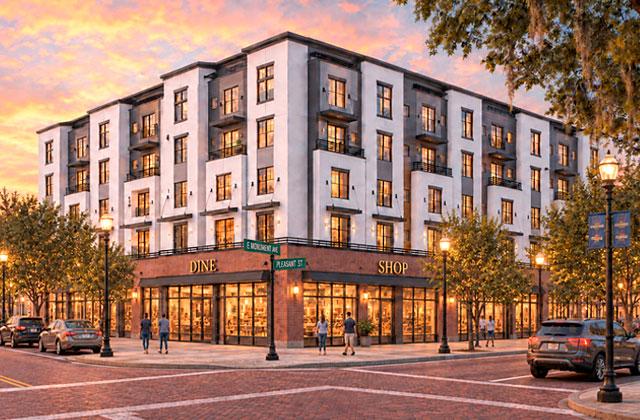
Kissimmee City Commissioners approved SkyView’s development plan for a five-story hotel tower and four-story condominium building with street-level retail space to be build around the Toho Square parking garage in the downtown area. (Photo/City of Kissimmee)
After two weeks of talks, the Kissimmee City Commission has finally approved a plan for its Gateway Airport to raise landing fees and to update its contract with a vendor to bill and collect the fees using camera technology.
Also at their Tuesday meeting, commissioners approved the development plan for a branded hotel, condominiums and retail space to wrap around the Toho Square parking garage on Pleasant Street near the lakefront.
The landing fees, charged to pilots not based out of the Kissimmee airport, will increase from $3 to $3.75 per 1,000 pounds of craft weight. The agreement with Vector now includes the language to allow for the cameras to identify the aircraft and send bills.
As its was at the prior meeting in September, the topic was contentious. Those representing pilots said the fees, which went into effect in February 2025, would spell gloom and doom for the airport and the surrounding areas, as other executive-sized airports are not charging the fees.
“This could be a more successful airport, but you’re leaving money on the table,” pilot Don Frano said.
But airport Director Shawn Germolus noted that payments on improvements like a new air traffic control tower and taxiway upgrades, which are receiving federal funds but require a local match, will come due, and as a facility that must fund its own operations, everything comes down to the bottom line.
“We need the visitors using our airport to pay to cover those payments,” Germolus said.
City Manager Mike Steigerwald shared data that showed the fees were doing that job: About $400,000 were charged in fees in 2025, $372,000 was collected and $55,000 was paid to Vector. Thus far in 2026 (it’s not clear yet up to what month the data goes through), $335,000 was invoiced and $296,000 has been collected.
Germlous said that, at a meeting between the last time the Commission met, when the approval vote was 2-2 with Commissioner Carlos Alvarez absent and didn’t pass, those representing pilots suggested planes under 12,500 pounds be exempt from the fees. But Germolus said 75% of the airport’s traffic is under that weight.
“They suggested an increase on fees for the bigger jets, but that’s a gamble we can’t afford,” he said.
Germolus also noted that development on the former Kissimmee Golf Club, on the other side of the runway complex, is planned, and revenue from that would enable the airport to eventually lower runway fees.
“Give us two years on that,” he said. When it came time to vote, with Alvarez still absent, the four commissioners agreed to approve the motion to increase the fees and to hold a workshop before the end of the year to look further into the matter.
“We have to meet those obligations,” Commissioner Janette Martinez said of the matching payments for the federal dollars directed at the capital improvements.
As for the Toho Square project—the second such hotel project slated for downtown Kissimmee after the Azure project on the Kissimmee Civic Center site, which should begin boldly moving forward this winter—commissioners got the nuts and bolts of the development agreement Tuesday, which they approved after selecting SkyView as the developer in July 2025.
The plan includes 100-120 hotel rooms in a five-story tower at the corner of Ruby Avenue and Pleasant Street, 18 to 20 residential condo units intended for owner occupancy in a tower that will include ground-floor retail space at Monument and Pleasant, a pocket part immediately behind the condos, and a linear park with a walking path around the project.
The agreement with Skyview, which also developed The Allen apartment project near HCA Florida Osceola Hospital, outlines responsibilities, development milestones, and financial commitments for the project. Per the agreement, the Downtown Kissimmee Community Redevelopment Agency will use about $1.5 million of a $4.3 million investment of tax increment generated within the downtown redevelopment area, to reimburse public infrastructure and site improvements, including utility and stormwater upgrades and railroad noise mitigation. The remaining $2.8 million will be provided through the Pioneer Project Incentive Program, a city economic development initiative to incentivize such projects, over five years after each phase receives its certificate of occupancy.
A ground floor grocery store or supermarket, which commissioners like Angela Eady had asked for in the original proposals from 2025, are not part of this design.
“I didn’t want to add more families to downtown who don’t have access to a local supermarket,” Eady said Tuesday.