

Board will meet in Tallahassee on Oct. 23 to approve the recommendations

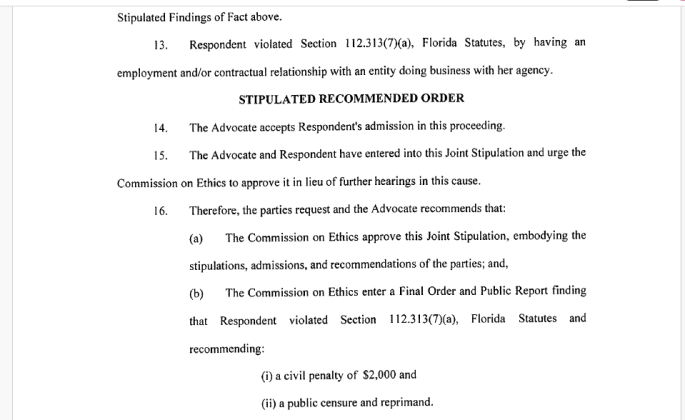
Released Wednesday, the Florida Commission on Ethics has suggested a civil fine of $2,000 and public censure and reprimand.
The Florida Commission on Ethics will meet on Oct. 23 at 8:30 a.m. in Tallahassee to approve a recommendation of action against Kissimmee Mayor Jackie Espinosa for her relationship with three companies that accepted money from a city fund designed to help small businesses still recovering from the COVID-19 pandemic.
Released Wednesday, the Commission has suggested a civil fine of $2,000 and public censure and reprimand.
In Wednesday’s “Joint Stipulation of Face, Law and Recommended Order” obtained by the News-Gazette, Espinosa admits to a violation of Florida Statute 112.313(7)(a), involving a contractual or employment relationship with an entity that conducted business with her own government agency. voted unanimously on Aug. 28 that it found probable cause Espinosa had created such a violation.
While that would conclude the Ethics boards’ involvement in the case, which does not carry any criminal charges, the Florida Department of Law Enforcement, which had agents in Kissimmee in late August to interview Kissimmee officials and others connected to their investigation of the case, and the state office of the Chief Financial Officer, could still weigh in. State CFO Blaise Ingoglia reportedly turned over his office’s findings to FDLE.
At an Aug. 18 City Commission meeting, Special Prosecutor Mayanne Downs presented the City Commission with her findings that Espinosa violated city ethics codes by voting to create and fund the “Business Boost 2.0” grant program with the city’s remaining American Rescue Plan Act (ARPA) recovery funds while the three businesses tied to her and her family received $50,000 from it. While Downs recommended that the city could hold impeachment proceedings and to refer the matter to the FDLE, only two of the other four commissioners voted to do that. Lacking three votes, that also ended the city’s role in the matter.
Among the facts stipulated in the findings, it concludes Espinosa voted to create the plan — but not to approve grants to any businesses — and the city did not deny funds to any businesses that applied and met the criteria of being in business in the city during the pandemic and suffered financial hardships.
Espinosa is dealing with a family emergency this week and sent a statement saying she’s agreed to accept the Commission’s stipulation.
“Continuing through the proceedings with an evidentiary hearing could have extended the matter well into 2027. After weighing the available options, I believe resolving it now is the appropriate path forward,” she said. “I thank the Florida Commission on Ethics and its staff for their professionalism and courtesy throughout this process. I respect the Commission’s role and appreciate the manner in which this matter has been handled.
“Although the matter has been portrayed as criminal and political considerations have shaped public discussion, it has always been governed by applicable ethics laws and procedures. I have respected the process and look forward to the Commission’s final action and I am ready to put this chapter behind us and focus my full attention on what matters most: serving the people of Kissimmee, as I have since day one, with professionalism, integrity, and dedication.”
The Commission’s suggestion of the fine and censure has not sat well with a number of Espinosa’s constituents. Resident Claudio Zuco, who filed a complaint directly with the Commission, said full restitution should be in order.
“A $2,000 fine does not begin to compensate the community for the substantial public funds lost as a direct result of the actions under review. The financial toll inflicted on Kissimmee’s taxpayers stands at $75,000,” Zuco said. “$50,000 in misallocated grant funding wrongfully taken from municipal resources; $25,000 expended by the City of Kissimmee to retain a special prosecutor to investigate this matter—an expense incurred only to reach the identical determination later echoed by (the Ethics Commission).
“I urge the Commission to reject the current terms of this lenient stipulation and enforce full financial restitution as a prerequisite for any final resolution.”