

In the first responder line of work, when seconds count, it is helpful to get eyes on a scene as quickly as possible, to relay information directly to responding officers.
Thanks to technological advances, those eyes are available—and the St. Cloud Police Department has them.
Tuesday, the department gave a deep look into its Drone as First Responder (DFR) program, the first in Central Florida, designed to enhance emergency response times and significantly increase the safety of both the public and first responders.
While law enforcement, including SCPD, has been using drones for the better part of a decade, they’ve been used at the scene, meaning officers must drive them there, then set up and initialize them before flying them themselves.
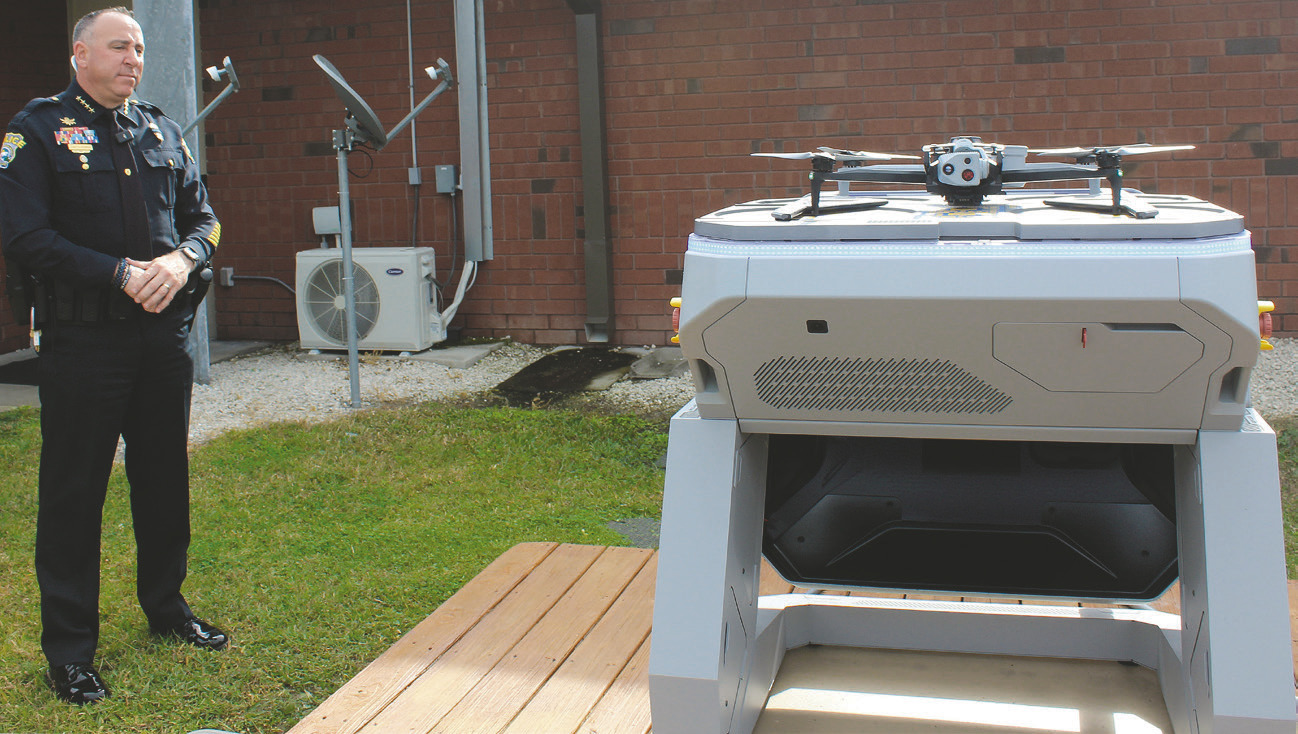
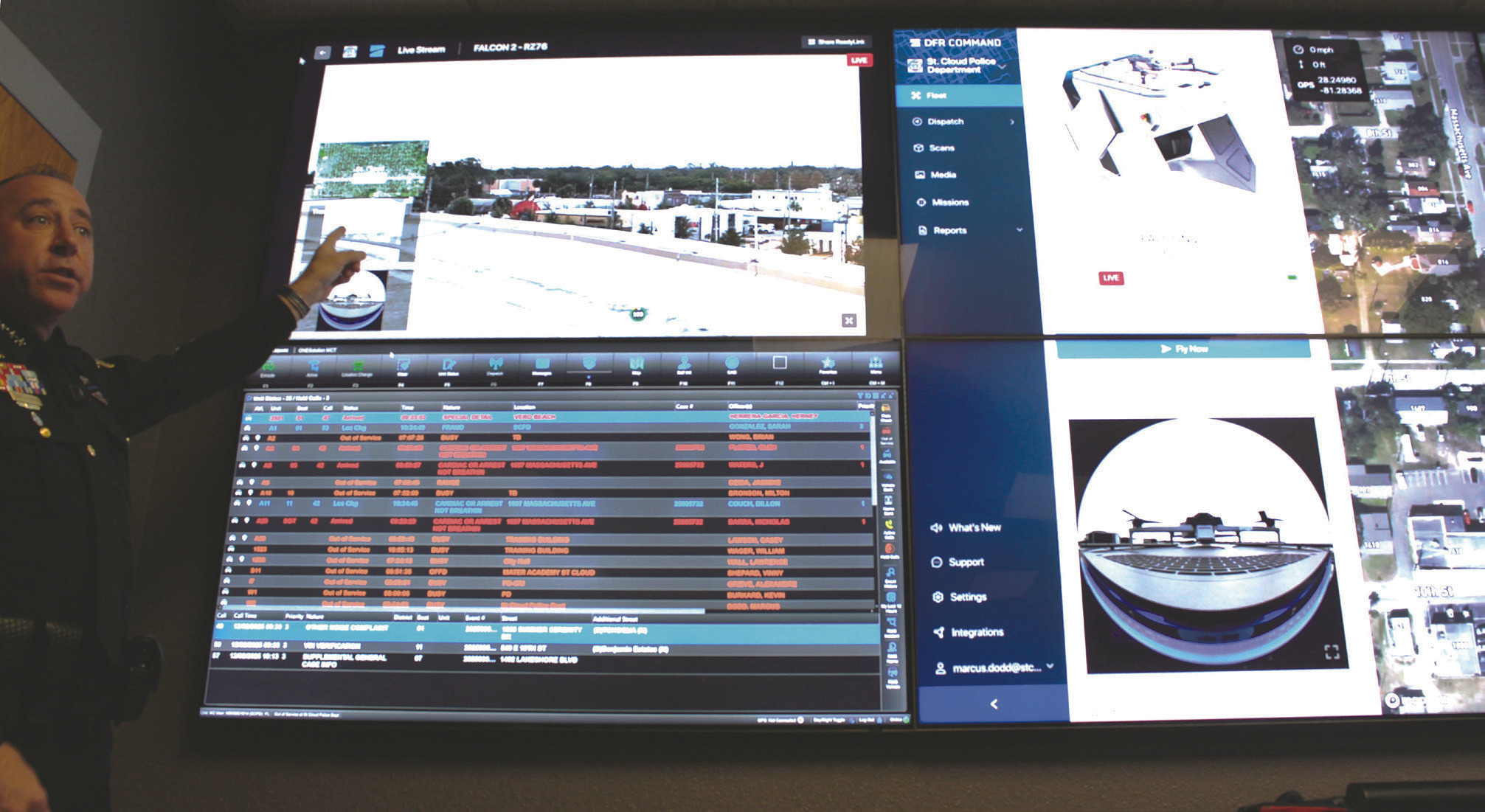
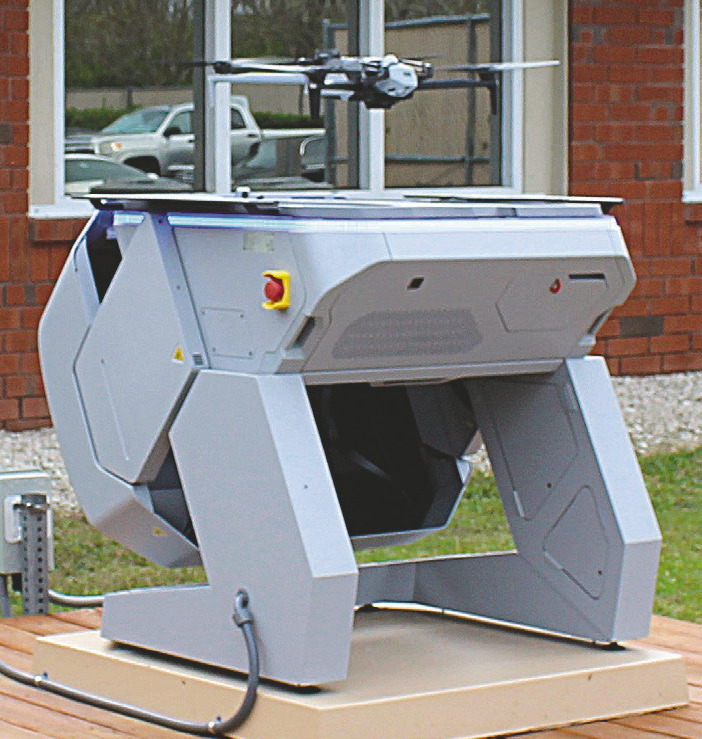
Now, they can be deployed and flown from SCPD’s Real Time Intelligence Center from two docking stations at SCPD or the roof of City Hall. They travel 200 feet above the “as the drone flies” as fast as 35-40 mph—no getting stuck at red lights in city traffic—to provide responding officers and fire rescue personnel with real-time aerial intelligence before they arrive on the scene. Armed with critical, real-time information such as the identity of those involved, the extent of a fire, or if a suspect has a weapon and the direction they are fleeing, responders—who are leaving the flying to others—can focus on making better-informed decisions.
Two more drones and docking stations are planned, one to go on a tower along Narcoossee Road.
St. Cloud Police Chief Douglas Goerke is concluding his fourth year at the helm. He notes that statistics show St. Cloud is one of the state and country’s safest cities of similar size, but law enforcement must continue being proactive to stay one step ahead of “the bad guys”.
“We use cutting-edge technology to make that happen, it’s not easy to do every day,” he said. “We give our officers the very best technology to ensure they are well-prepared to deal with anything they encounter.”
The drone system, a $890,000 city investment over five years for the SkyView equipment and subscriptions, is one of those technology upgrades Goerke has overseen, including upgraded body-worn cameras, tasers, cameras and training simulators. At a community breakfast meeting last month, Goerke referenced the system.
“Imagine an elderly person leaves their house unexpectedly and gets lost. Seconds matter, and it means deploying resources: officers, canines, getting a helicopter up, which can take 30 minutes to get in the air. Utilizing this type of technology that responds in seconds, it ensures the public’s safety.”
Within 20 seconds, the drones can be launched and on the way to a scene. SCPD has an FAA waiver for non-line of sight flight, with personnel in the intelligence hub flying and relaying what it sees to responders on the ground. And, it can see all of that from a safe distance; personnel showed off Tuesday how it can zoom in on a location from nearly threequarters of a mile away.
They can go up in inclement weather that a helicopter can’t fly in, and feature built-in radar and sensors to avoid buildings and other solid objects. In cases of long-lasting situations where battery life may run low, the drones can be lowered to an officer who can swap out the battery.
Real-time information on where the drones are is available on the city’s website.
“We can get a drone overhead in seconds, and shared detail of what’s going on in real time,” Goerke said. “We can call a trauma alert based on what we see; think about a large-scale car crash and being able to share these video feeds with the doctors that will be treating the victims who will be coming in as paramedics are extricating them from vehicles. That cuts down that time for life-saving efforts—getting CAT scan or surgical units ready before they arrive.”
That detail includes being able to relay critical information to law enforcement, such as if a suspect is armed—with what, and in what hand or pocket— that’s never been available until they rolled up on a scene and had to make critical decisions in their own real time.
Now it is. “This is another tool to get that information prior to getting there,” Goerke said. “There’s nothing worse in a critical incident than trying to assess everything in a split second. When seconds matter, and lives matter, this is the future of public safety.”