


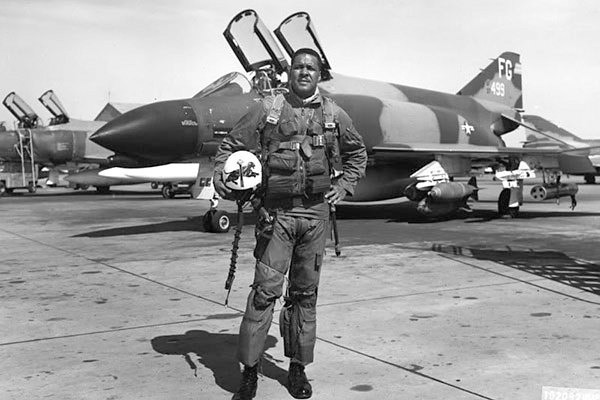
Daniel “Chappie” James was born in 1920 near the Pensacola Naval Air Station in a segregated town. Growing up, he often saw planes flying overhead and stated his desire to become a pilot.
When the U.S. entered World War II, James was attending Alabama’s Tuskegee Institute on a football scholarship. He enrolled in the flight training program and, in July 1943, he earned his pilot’s wings and a commission as a 2nd Lieutenant, making him one of the famed Tuskegee Airmen, the first black pilots of the U.S. Army Air Force. His assignment as an instructor pilot kept him from serving in combat overseas during that war.
He remained in the Air Force, and during the Korean War he few over 100 combat missions in F-51 and F-80 fighter bomber aircraft. He was awarded the Distinguished Flying Cross in 1950 for leading a flight of F-51 Mustangs in a close air support mission in support of U.N. troops in danger of being annihilated by enemy forces.
During an assignment at Otis Air Force Base, he was selected “Young Man of the Year” for 1954 by the Massachusetts Chamber of Commerce.
In June 1967, Col. James became Vice Wing Commander of the Eighth Tactical Fighter Wing in Thailand under the command of Colonel Robin Olds. Chappie flew 78 combat missions over North Vietnam. On one mission he led a flight in the Bolo MIG sweep in which seven MIG-21s were destroyed, the highest total MIG kill of any mission during the war.
James assumed command of Wheelus Air Force Base, Libya in 1969, in the wake of Libya’s Col. Muammar Khadafy’s coup. James recalled an incident with Khadafy shortly after the takeover.
“One day Khadafy ran a column of halftracks through my base—right through the housing area at full speed. I shut the barrier down at the gate and met Khadafy a few yards outside it,” James said. “He had a fancy gun and a holster and kept his hand on it. I had my .45 in my belt. I told him to move his hand away. If he had pulled that gun, he never would have cleared his holster. They never sent any more halftracks.” His handling of the Khadafy incident prompted President Nixon to nominate him for Brigadier General in 1970 and two tours of duty at the Pentagon.
Gen. James became the first African American four-star general in the history of the U.S. military in August 1975 with his assignment as Commander in Chief, North American Air Defense Command. He died in 1978, less than one month after retirement from active service.
In May 1987, then-President Ronald Reagan traveled to Tuskegee Institute and spoke at the dedication of the Gen. Daniel “Chappie” James Jr. Center for Aerospace Science and Health Education.
“When he was commander of NORAD, all of America had depended on James’ judgment and courage for survival in the face of nuclear threat,” Reagan noted. “He had four stars on his shoulder and 50 stars in his heart,” Reagan said.