

UF-IFAS Extension Services
Keith Schneider, a University of Florida food safety expert in the University of Florida Institute of Food and Agricultural Sciences food science and human nutrition department, shared his top tips for meals that deliver time and again, while minimizing the chances you’ll find yourself in the emergency room enjoying leftovers these holidays.
Keep cooked foods out of the “danger zone.” “Bacteria multiply between 40-140 degrees Fahrenheit. Since most people aren’t monitoring those temperatures closely, be sure to refrigerate leftovers within two hours of being cooked or being removed from the heating source. If you’re going to leave a dish on a warming tray or in the oven, you’ll want to cool it down before putting it in the refrigerator. But the clock starts once the temperature drops below 140 degrees.”
For foods that are served cold, the same “danger zone” applies. Your refrigerator is typically set at 38 to 40 degrees. Any of the pathogens of concern are not going to grow below 40 degrees. When you take out a salad or a pumpkin roll with cream cheese filling, that also shouldn’t spend more than two hours above 40 degrees. The higher the temperature outside the refrigerator, the shorter the time it should be out. Here in Florida, we can have some warm, humid holidays – be aware when you’re eating dinner on the back porch and shorten that time out of the fridge.
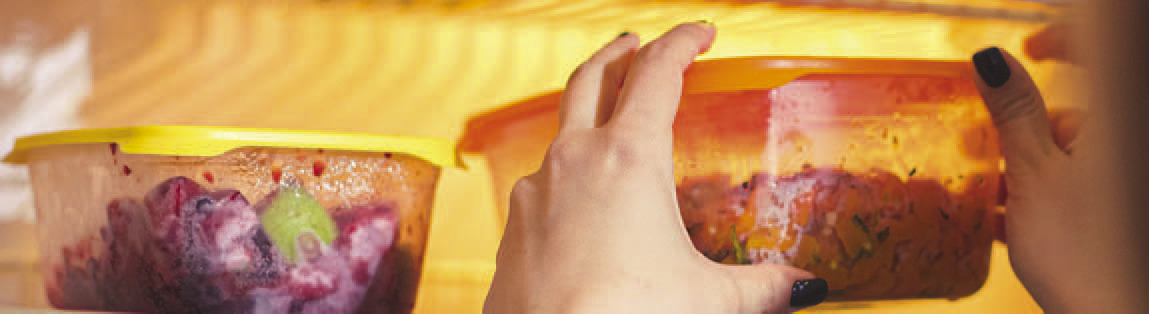
Use shallow containers to ensure adequate airflow and even cooling. Don’t throw piping-hot gravy that was kept in a hot dish right into the refrigerator, because it has all that residual heat. Make sure you’re allowing for maximum cooling. This includes transferring to shallow storage dishes, allowing to cool some before refrigerating, and ensuring airflow above, below and around to facilitate the cooling. If you stack everything, it could take hours and you could literally heat up the whole refrigerator.
Most items can go into either the refrigerator or the freezer. If you think you might not eat something within three to four days, the general limit in the refrigerator, freezing would be a better choice. Vacuum-sealable bags are a better storage solution, since issues with frozen foods tend to be more on the quality side than safety.
The “smell test” isn’t good enough. “Pathogens typically don’t grow to a density where they’re going to have an odor. The odor typically occurs from spoilage. But if it’s been a few days and still smells fine, it still may not be safe. “When in doubt, throw it out.”
Reheat leftovers to 165 degrees Fahrenheit. Only take out the portion that you’re going to eat, as opposed to the entire dish. Whatever you plan to consume, get it to that temperature to kill any pathogens that may have germinated. For turkey, as an example, the organism of concern post-cooking is clostridium, which will die at 165 degrees. But it’s a spore former, and the spore will survive high-temperature cooking; then when it cools, it will germinate and start growing again.”
Minimize heat-thaw cycles. Foods served cold don’t have that kill-step option. Be sure to prevent cross- contamination. Ensure that they’re in sealed containers and be aware that every time you remove them from the refrigerator, each thawing cycle adds heat energy that allows pathogens to grow. The problem is that it’s a cumulative thing – two hours out of the fridge the first day, plus an hour the next, adds up to accumulated growth.
Your leftover sandwich is fine cold, providing you cooked it properly to start. As long as your turkey and other ingredients were cooked and stored properly, the pathogens aren’t going to magically grow. If you’re worried about it, heat the turkey and have a warm sandwich. But taking those steps in the preparation, cooking and storing process means you should be safe to enjoy a cold leftover turkey sandwich.