

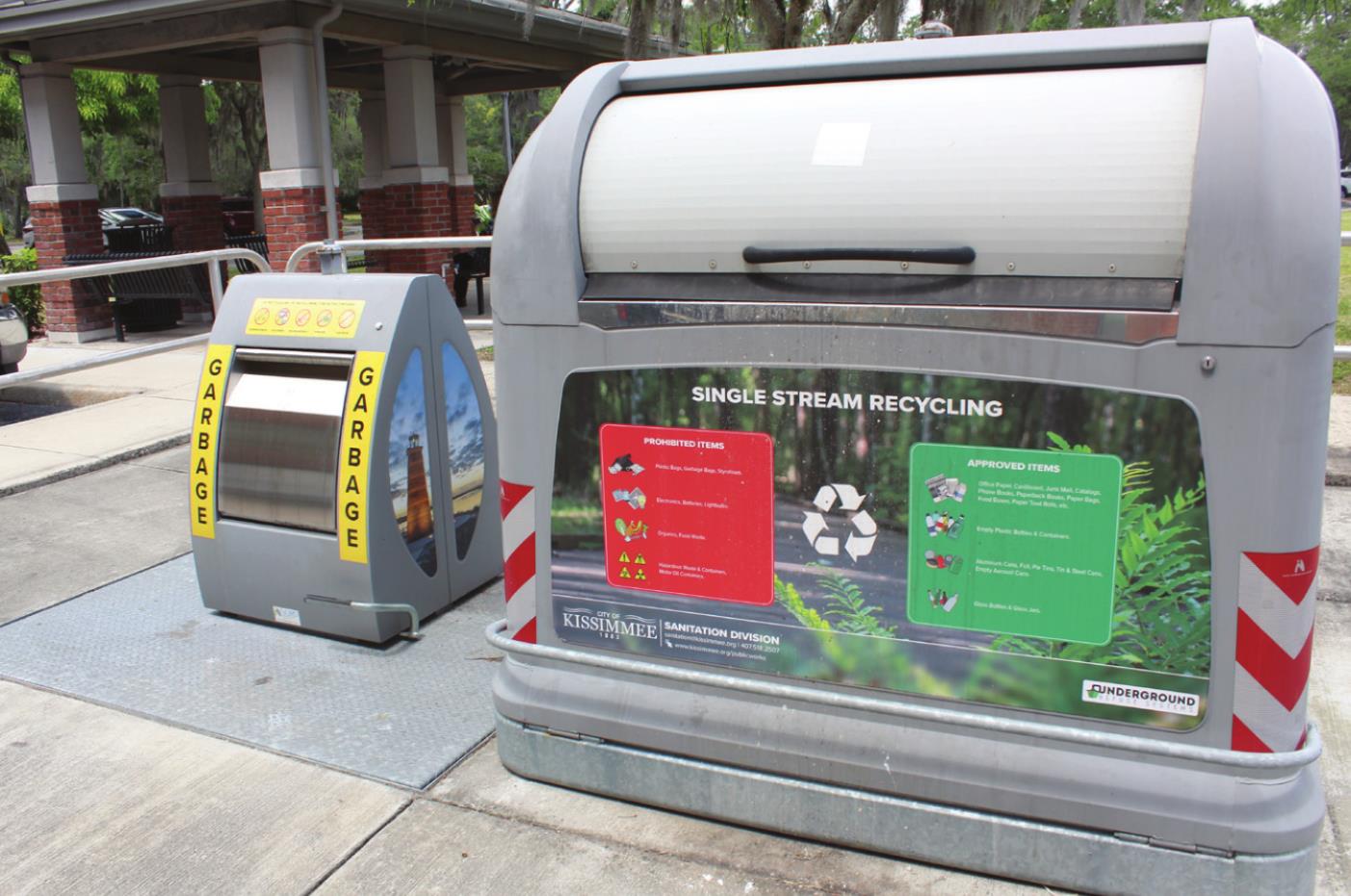
The collection of trash, recyclables and solid waste at the city level isn’t as easy as waiting for a truck to come down your street on its assigned day.
In the city of Kissimmee, for instance, there are as many as six contracts with different entities, who serve residential areas, commercial properties and businesses, and city facilities like parks.
Residential pickup servicers use those rolling bins familiar to homeowners, commercial collectors work with the familiar box dumpsters, and in downtown Kissimmee as well as a city apartment complex, bins located in underground concrete bins are used to mitigate smell, rodents and people who want to pick through the trash.
Those underground bins are technology of Underground Refuse Systems, which offers specialized trucks that lift and empty the bins. URS also uses above-ground, portable receptacles that are emptied by the same lift trucks, that get a call to come empty them when sensors inside send a message that they’re full.
Those receptacles from Underground Refuse Systems can’t burn up, float away or fly away.
There’s one truck, made by NORD Engineering, that services URS receptacles in Kissimmee. The city is considering purchasing a second truck, in order to expand service.
At its last City Commission meeting, the city’s Solid Waste Division presented that it also has plans to add 14 more of the portable URS units, to replace dumpsters in the city.
“Downtown is moving forward (with the underground technology),” City Manager Mike Steigerwald said. “In other places, the best time to build this technology is when you’re developing.”
URS founder Jay Wheeler started in Kissimmee because it was a place where preparation met opportunity.
“It was a great opportunity, and we offered superior technology. Other solid waste companies have old, obsolete technology, and they don’t want to evolve. The dumpster is 83 years old. This is also the only technology in the field that controls rodents. Trash collection is infrastructure, like water and utilities.”
Wheeler said its system eliminates odors, rodents, and people picking through trash.
“When the homeless find contaminated food in a dumpster, get sick and end up in the hospital, that’s on the taxpayers dime,” he said.
With the system now in use in Kissimmee, Clearwater and Ennis, Texas, the plan is to expand around the country like it’s expanding right here in its original location. Wheeler’s company has attended events, or reached out to municipalities, in other parts of Texas, California, Michigan and the Columbus, Ohio and Las Vegas areas.
“I spend a lot of my working time right now in sales and marketing,” he said. “We’re busy.”