

It’s on the lips of anybody who lives or works in Osceola County: transportation.
Issues with roads, where, how and when they’re getting expanded or built, and how local leaders are working those plans into the growth the county is seeing.
State Rep. Paula Stark brought those who lead those efforts together last week to talk about master plans for the area, which go out to the year 2050.
By then, the area — Osceola, Orange and Seminole counties — are expected to have one million more residents, and will have to understand the impact of 75 million annual visitors. That means more people on the road, and those won’t all come in traditional passenger cars. It also means a higher number of freight vehicles and, thanks to technology, more electric cars and driverless vehicles.
A number of concepts that Metroplan and the local leaders discuss include:
Vision Zero— an initiative to curb fatal and serious-injury crashes “It doesn’t say you won’t have any crashes, it says we’ll look at things differently to reduce fatalities,” MetroPlan Orlando’s Executive Director Gary Huttmann said. “It’s going to take a change of behavior, taking responsibility for some of the cars around you.”
From 2018-22, the three-county area saw 325,000 crashes — about seven per hour – with 9,160 serious injuries and 1,477 deaths, nearly one per day. And it’s only going to increase with more lanes, if speeds don’t decrease.
Metroplan’s 2050 plan — Huttman said it is heavily focused on technology in how transportation systems are managed.
“As I think about Osceola, for years, the county struggled to get in on the process and shortchanged on some transportation investments, but with the leadership currently in the county, that’s changed. It’s happened through participation and being at the table with a voice, he said.”
Road projects, and how they’re being funded— Tawny Olore, the Executive Director of Osceola’s Transportation and Transit Department, gave an update on a handful of major road projects that will be under way at some point before the calendar flips to 2024.
Simpson Road widening is under way, and will be completed from Boggy Creek Road to Myers Road by 2024, and to U.S. Highway 192. Work on Neptune Road is out for bid and will start this year; widening on Partin Settlement Road and Poinciana Boulevard is under way, and the preconstruction phase on Boggy Creek from Simpson to Narcoossee Road (which passes four schools and the Austin-Tindall Sports Complex) will begin before the end of the year.
Through the year 2026, the official flower of Osceola County might as well be the orange road cone.
“And I didn’t want to talk about the Lakeshore Trail project,” she said, quickly noting that while Lakeshore Boulevard is again open to traffic, the trail project will be done next year.
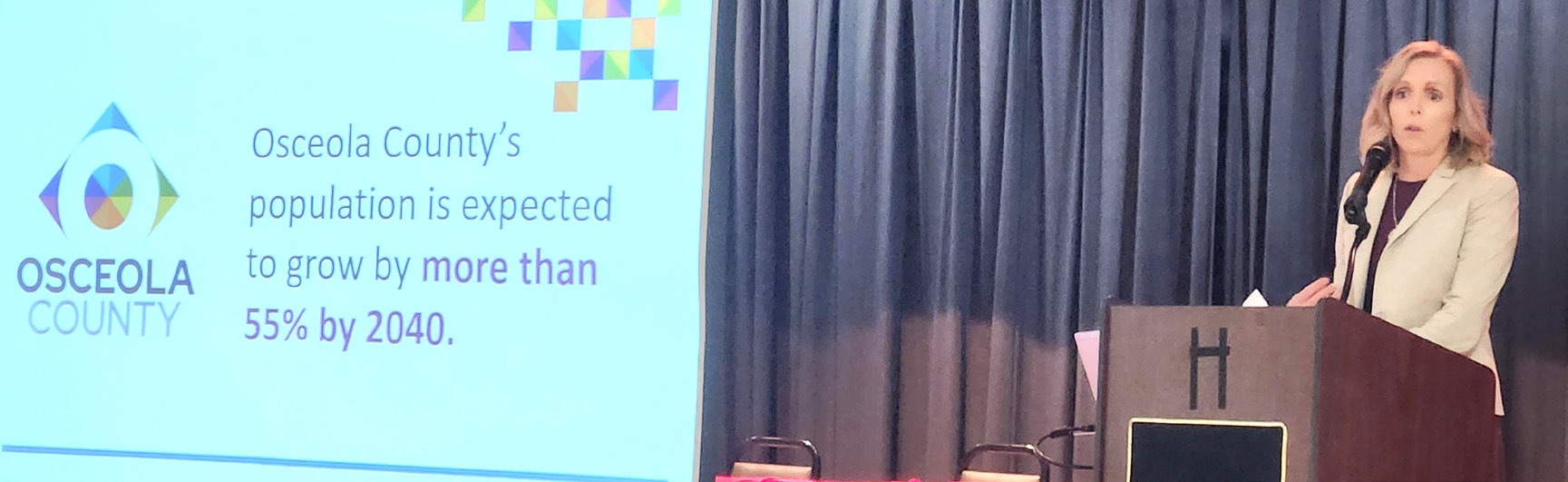
With the county’s population growing by 25 percent in the decade from 2010-20 — and expected to grow another 55 percent by 2040 — there’s “a lot of pressure” on the county’s infrastructure system, Olore said.
She also spoke of the process that a road project goes through, from concept to design to right-of-way acquisition to construction — about five to 10 years, and it depends if the funding source is local, state or federal dollars. The closer the source is to Osceola County, the quicker the project can be completed thanks to, for example, the amount of “hoops” and regulatory steps a job funded federally must go through.
Recently, Osceola County reworked its debt service on Osceola Parkway to free up $2 billion or so to fund many of these projects themselves, in order to keep them moving.
And since both the state and federal governments do not have a funding source tied to growth, the county is looking at mobility fees, increases in property taxes tied to rising property value and some sales taxes to keep them going, especially to fund projects planned down to the street level for growth expected to the direct east and south of Lake Tohopekaliga.
What’s up in St. Cloud?
Assistant City Manager Dave Tomek, a veteran of road projects, noted a number of capital improvements coming to town. While a study on making 10th Street safer has been a popular topic, the city is also looking at making 5th Street another east-west thoroughfare through town without stop signs, and extending 17th Street to Old Hickory Tree Road, to provide another thoroughfare in and out of a district that contains Michigan Avenue Elementary and St. Cloud Middle and High School. Traffic signals added at Nova Road and 192 and Deer Creek and Canoe Creek Roads have enhanced safety.