

Osceola County’s leaders have made steps, with help from state and federal funding partners, to improve the quality of local water, in Lake Toho and the water that comes into homes in one historic area.
Over $2 million in state and federal funding is flowing into the Whitted neighborhood, a historic community near Narcoossee, to bring Toho Water Authority lines to the neighborhood’s homes and end a reliance on old, contaminated wells to bring safe, clean, reliable water.
This project is possible through the dedicated efforts of state Rep. Paula Stark and Sen. Victor Torres in Tallahassee and U.S. Rep. Darren Soto to bring the appropriations. However, efforts by those like community activist Jennifer Paul and County Commission Ricky Booth made the need an issue.
Whitted was settled by Black families during the post-Civil War Reconstruction period. It has maintained its heritage through generations—Paul was born there. Locals know it is an area of rapid development, and when a developer bought a neighboring piece of property, Paul and her family brought it to the county’s attention, and Booth helped deny a proposed townhome development on it.
“We wanted to preserve the integrity of the community,” Booth said, noting the establishment of the Whitted Preservation District.
Paul said the area has had such problem with its water, dating back to the 1970s, that the local church had shut off its service due to potential contamination. The Florida Department of Environmental Protection investigated the site in 2022 and confirmed elevated levels of contaminants in the soil, which furthered the need for the project.
“My uncle, James Paul, remembers a time when the land they wanted to build on was a dump,” Jennifer Paul said. “The heart of the problem were these private wells. Some lots had rebuilt homes on them, but nothing had been done to the wells.”
The funding is now in place to get the neighborhood hooked up, including permitting fees, to Toho Water lines now in the immediate area with the Sunbridge community growing just to the south.
“We’re hoping to see the project started this year,” Paul said.
“We’re proud to have had this collaborative effort with our state and federal leaders to get this done for the community,” Booth said. “It’s a great thing, especially if their system is as contaminated as the (EPA) said it is.”
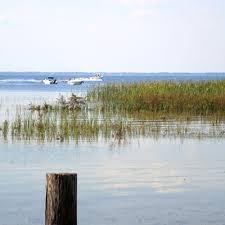
On Lake Tohopekaliga, the county has announced it will receive a $640,000 state appropriation aimed at reducing vegetation in the lake’s northern end, closest to the city limits.
The money will fund a onetime vegetative harvesting project designed to improve flood conveyance for the Upper Kissimmee Basin, which includes Mill Slough and other ditches that run into Lake Toho. addressing concerns highlighted by the flooding experienced during Hurricane Ian in 2022.
Commissioner Cheryl Grieb, who lives close to the north end of the lake, said addressing the overgrowth of invasive plants like hydrilla will make residents happy, not just for esthetics but for flood control. Recent development in the area has restricted opportunities to mitigate sediment and nutrient inflows, leading to increased flooding. The Dellwood and Mill Run areas experienced unprecedented flooding during Hurricane Ian in 2022.
“We’re hoping this isn’t just a one-time thing,” said Grieb, who has been fighting at the state and federal level for help with this issue since she was a Kissimmee city commissioner over a decade ago. “When the state told us we were responsible for this, we told them, ‘You’re supposed to help us, not the other way around.”
If this year’s hurricane season is as busy as 2022, or if another Ian-like storm hits, the county now has more space for floodwaters to go, with a mitigation pond at NeoCity now available where storm water can be diverted.
The Florida Fish and Wildlife Conservation Commission, the agency tasked with this responsibility, also received an additional one-time appropriation of $3 million to address invasive plant species throughout Central and South Florida–including lake Tohopekaliga. Grieb said, in general, the FWC and South Florida Water Management District are tasked with providing money making those funds available for local governments to tend to things like the lake.
Then, at Monday’s County Commission meeting, the board approved the Shingle Creek and Kissimmee River Water Resources Defense Act (WRDA). It’s a project to, over the next three years, work with the Army Corps of Engineers on improving flood mitigation and the overall ecosystem of Shingle Creek, the Kissimmee Chain of Lakes and Kissimmee River.
“When you’re working with the federal government, it can be a process, but we’ve been talking with them for months,” Grieb said. “But these are things we just can’t do at the local level.”
The county and federal government will share in the $3 million price tag; part of Monday’s approval was to apportion the $1.5 million in the county’s budget.