


Remember last hurricane season, when we blasted through the alphabet thanks to an unusual number of storms, and had a handful of Greek-named storms?
Well, it may not be that busy this year, but the researchers from Colorado State University who give us predictions for named tropical storms and hurricanes boosted their outlook for the rest of the 2021 Atlantic hurricane season in a revised forecast issued July 8.
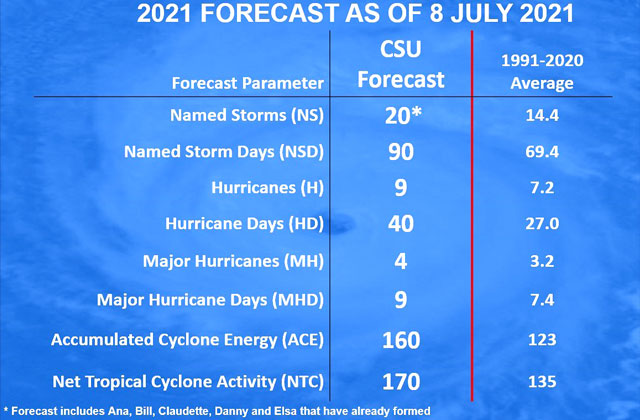
Researchers Philip J. Klotzbach, Michael M. Bell, and Jhordanne Jones have predicted 20 named storms, up from 17 in their forecast issued in April. That would take us through the ‘V’ storm. The National Hurricane Center does not use Q, U, X, Y or Z names.
The 20 figure includes the five storms already named in 2021. Elsa came ashore on the west coast of Florida on July 7 after becoming the season on July 2.
New forecast calls for nine hurricanes (up from eight) and four major (Category 3 or higher) hurricanes.
Elsa, which formed in the Tropical Atlantic and went through a burst of rapid intensification, a rarity for late June or early July, got the CSU research group’s attention.
“Elsa’s development and intensification into a hurricane in the tropical Atlantic also typically portends an active season,” their report said. “We anticipate an above-normal probability for major hurricanes making landfall along the continental United States coastline and in the Caribbean.”
This year is forecast to be the sixth straight aboveaverage U.S. Atlantic hurricane season. The record 2020 season had 30 named storms, which meant using Greek names for storms for the second time ever, and the first since 2005. Starting this year, if there are more storms after the ‘W’ name, an auxiliary list will be used rather than the Greek alphabet.
The Colorado State forecasters also said there is a 68 percent chance a major hurricane will strike the U.S. coastlines. In an average year that’s 52 percent. They also noted a 43 percent chance for the East Coast including Florida to be hit (up from 31) and a 43 percent chance of the Gulf Coast from the Florida Panhandle to Brownsville, Texas (up from 30) to get one. There is a 57 percent probability for at least one major hurricane to trek through the Caribbean; the average for the last century is 42 percent.
Those increases are based on a lack of any El Niño conditions, which typically reduce Atlantic hurricane activity through increases in vertical wind shear, forming, and the state of seas surface temperatures.
“The tropical Atlantic currently has near to slightly abovenormal sea surface temperatures, while most of the subtropical North Atlantic is warmer than normal,” the CSU report said. “This sea surface temperature configuration is typically associated with more active hurricane seasons.”
The revised Colorado State forecast is in line with the U.S. National Oceanic and Atmospheric Administration’s (NOAA) outlook issued in late May. Their forecasters called for between three and five major hurricanes in 2021, and between six and 10 hurricanes.
An average hurricane season in the Atlantic between 1991 and 2020 saw three major hurricanes, seven hurricanes and 14 tropical storms. The active period that began in 1995 caused the numbers in an “active” season to be upped from 12 named storms and six hurricanes.
But, as a reminder, no matter how many storms form, it takes only one intense one to strike your area for it to be a “bad storm season.”
The CSU research team will issue another update on Aug. 5.
The hurricane season began on June 1 and ends on Nov. 30.
“We anticipate an above-normal probability for major hurricanes making landfall along the continental United States coastline and in the Caribbean.”
— COLORADO STATE UNIVERSITY Repot