

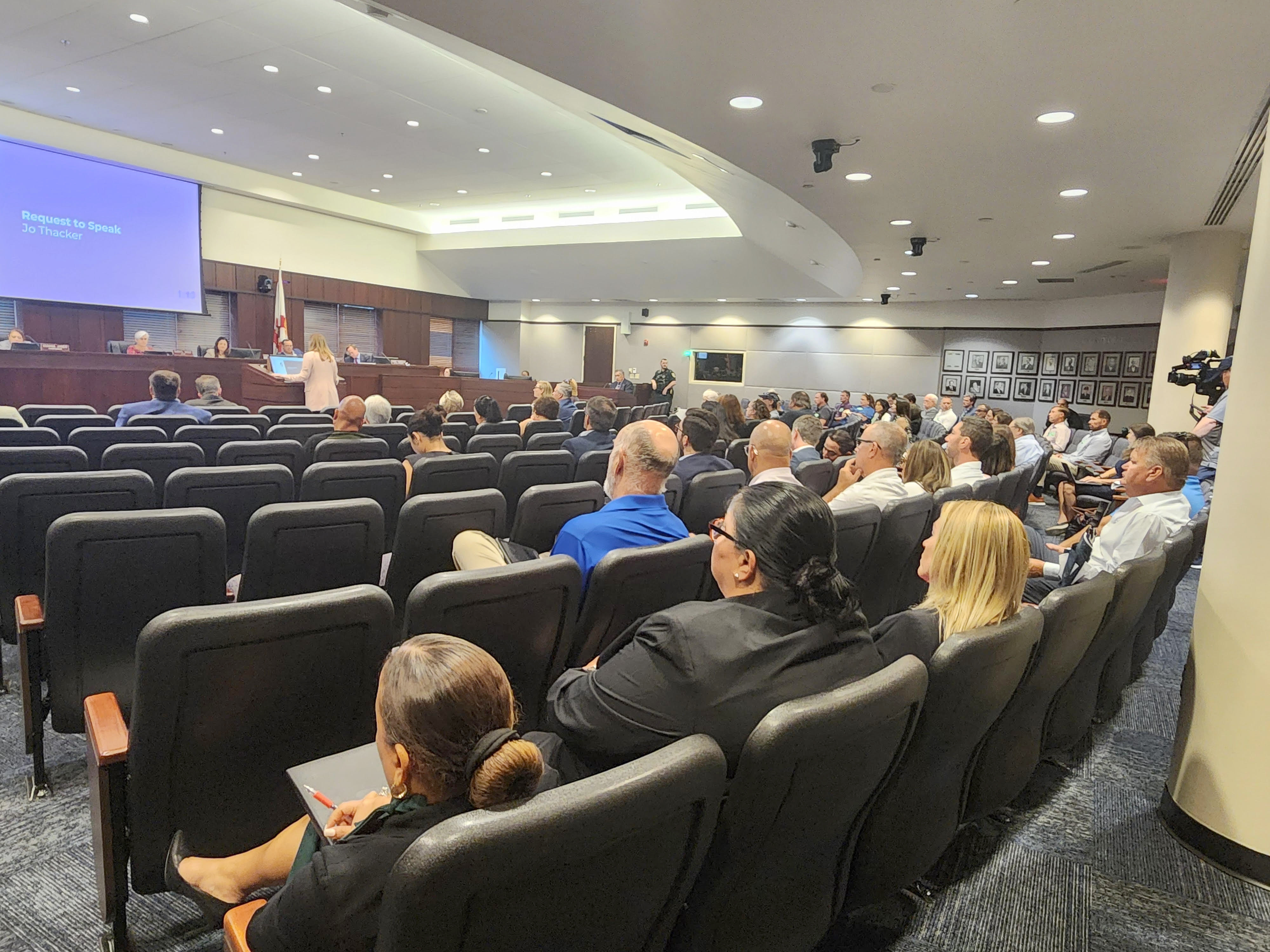
After months of discussion and work by county staff, Osceola County commissioners Monday voted 4-1 to approve an increased set of mobility impact fees charged on new construction.
With a philosophy that, “Growth should pay for itself,” the goal is to provide a funding mechanism for the county to build the roads and other infrastructure needed in order to meet the growing needs of a growing county with a growing population.
For permits pulled and projects processed between Dec. 19, 2024 and May 18, 2025, the new fees would go into effect on June 18. The December date represents a 90-day period mandated by state statute, and the June date is a six-month buffer the county agreed to as an alternative to phasing in the new fees over time. Commissioners agreed to that schedule, with County Manager Don Fisher noting that, for every six months the county waited to adopt new fees would cost it $20 million in funding.
The fee is paid one time when a structure is built. In many cases, the fees, depending on the type of new building — single-family house, office building, restaurant, store with a drive through lane — are doubling, or more.
The new fee schedule is based on a comprehensive study by transportation infrastructure and engineering firm HNTB Corporation. But, even with input from the land development sector, and creating separate structures for areas like East Lake Toho, South Lake Toho, and Alligator Chain of Lakes, which have an abundance of one sector of building over another, impact fees will rise dramatically in the first update to the fee schedule since 2018.
The impact fee for a single-family home will increase from $9,999 to $21,710-$25,012, depending on location. New stand-alone fast food locations with a drive through will see their fees go from $3,000 to $30,000, about a 1,000% increase. Those are among a number of increases.
In the ordinance that calls for the increase, the county cited “extraordinary circumstances relating to Transportation Infrastructure.”
“If unaddressed, (it will) result in conditions injurious to the public health, safety, morals, and welfare of the residents of the County and the State, threatening the sound growth of the County … The existence of such extraordinary circumstances creates an economic and social liability by hindering industrial, commercial, office or residential development, reducing employment opportunities, and negatively impacting construction.”
The topic of affordable housing was dealt with specifically. The county will set aside $3 million funds that will allow for the ability to waive some or all mobility fees on those projects. The county will also draft a policy that aligns with state statutes to determine what exactly an “affordable housing project” is that can qualify for a waiver.
A number of public speakers, from developers to builders associations to Realtors, spoke out against the increases. They noted the increases are “still alarming” and “barely defensible,” will raise property taxes, deter businesses from wanting to relocate to Osceola County and will, in the end as the state’s highest mobility impact fees, hurt the local economy. A speaker on behalf of the Apartment Association of Greater Orlando said the $20 million the county would lose over six months would be trumped by the $40 million in projects the county will lose if developers pull six projects out due to the higher fees.
Wes Robbins, president of the Greater Orlando Builders Association and a construction company owner, said he is “disappointed” that the county is acting based on what the industry calls a “flawed study”.
“We still don’t quite understand how the study was done,” he said. “While, yes, this is a one-time fee, this affects every person, including existing homeowners, because it will raise property taxes and fees as well ."
In fact, the only people to speak in favor of the new rates were Commissioners Brandon Arrington and Ricky Booth, who made and seconded the motion to approve. Commissioner Viviana Janer needed the six-month delay from December to June to get her approval. Commissioner Peggy Choudhry voted against.
“We live in a low-tax state,” Arrington said. “We need to hold new development accountable. We’ve delayed this since 2015, so we’ve probably given away $100 million we could have used for roads.”
Commissioner Ricky Booth noted the state hasn’t built a road in Osceola County in years and, without state-level buy-in, local governments are forced to raise those funds themselves.
“I heard the same concerns 10 years ago when we voted on the School Board to increase impact fees. I’ve heard these arguments before. None of them ever came true,” he said. “If you walk around District 5 and talk to my constituents about putting a huge impact fee on residential development, they’d probably jump for joy. The voice of the development industry is important, but none of them who spoke came up with a plan to raise the funds. They just said, ‘Don’t raise the fees.’”
Commissioner Viviana Janer called the action a necessity, and called for the policy defining affordable housing.”
“We’re really between a rock and a hard place,” she said. “In fairness, I still feel the need to phase these fees in, but I can agree to giving the extra time for project builders to be ready for.”
Choudhry, who cast the lone vote against, also asked for a phasing in of the new fees, and noted smaller increases in fees were put in place in 2017 and 2021.
But, in the end, not enough commissioners felt the same as Choudhry — and the rest of the building industry.